

It is Ash Wednesday, 2023. We wait in San Francisco’s new Harvey Milk airport terminal, a spectacular tribute to the progress made in gay rights in the fifty years since the San Francisco commissioner’s assassination. My husband Kent and I are on the way home.
“I’m not going to get any ashes today. Have you seen anyone with ashes on their foreheads?”
“I haven’t noticed,” he says.
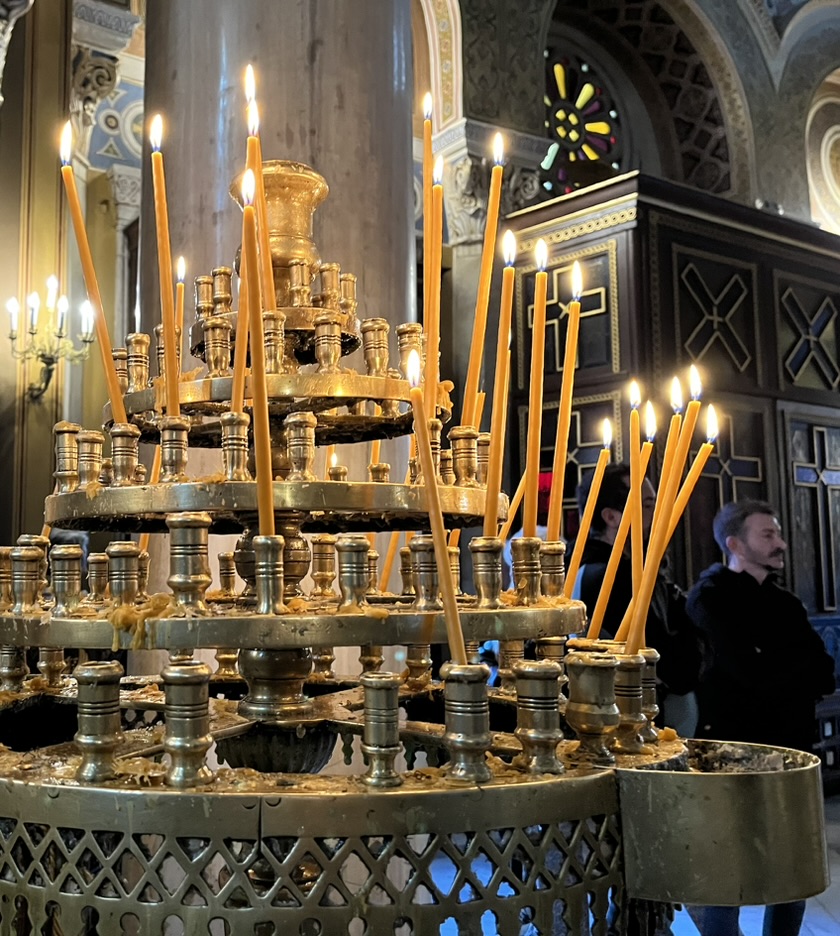
I was raised Presbyterian with a Swedish Covenant family background. Churches were plain. Crosses were bare, and there were no statues, few candles, and certainly none in front of statues of saints. Little glasses were passed along the pews for communion. There was no kneeling or walking to an altar. The Eucharist was a private affair between the pew-sitters and God. No one knew who participated and who didn’t. And no one put ashes on their foreheads on Ash Wednesday.
People walked up to the altar for a wedding or a baptism or were carried in a coffin for a funeral. They also went forward during evangelical revival meetings in answer to a call to be saved. Revival meetings, often held in tents, were not part of Presbyterian practices, but a couple of times, my Swedish Covenant relatives took me to tent meetings.
I still hear the preacher call on a long-ago summer evening, “Come forward to Jesus! Ask for forgiveness! Be saved!”
Am I saved? I wonder. Was it enough to say, “Now I lay me down to sleep,” each night before I go to bed and bring my dimes tied in a clean handkerchief for the offering on Sunday?
As if reading my thoughts, the preacher says, “Going to church on Sunday is not enough. Come forward!”
I give my uncle a questioning look. He doesn’t go forward, although lots of people do. I want to ask if he has already gone forward, but I don’t. He shakes his head, no, don’t go.
The preacher promises we’ll be “born again” and have eternal life in heaven instead of being tortured in the flames of hell. I worry about those flames of hell, but I know that even if I “get saved” tonight, nothing will change tomorrow. If I walk up and pray to get saved, I’ll be a hypocrite, which wouldn’t be good, would it? Maybe all those people going to the front are miserable and need saving. Will they go up over and over tomorrow, next week, or next year? Have they gone up before, or is once enough?
The preacher’s voice is compelling, “Come forward to Jesus!” My heart tells me I‘ll be damned if I do and damned if I don’t.
I sing silently, “Jesus loves me; this I know, for the Bible tells me so.” I pray, “Forgive me, Jesus. I love you, but I’m not joining that crowd. You’re not there, but with me here, aren’t you?”
That night, I dream of people screaming in the fires of hell.
Twenty-five years later, on my 33rd birthday, I married Ed, a divorced cradle Catholic. After years of soul-searching, I accompanied him to the St. Thomas Aquinas Newman Center at the University of New Mexico, partly because I thought his faith was stronger than mine. Newman reminded me of some of the more informal protestant churches I’d known. I attended classes, and after a nun said she wouldn’t tell me that I could not take communion, that it was a matter of my own conscience, I participated in everything, and our children were baptized.
Ed, divorced and remarried, was also not a bona fide Catholic according to official rules. He was eligible to apply for an annulment but refused to do so.
“I was married with six children. An annulment declares a marriage never existed. That is not true. My marriage was alive and good, but it died.” Like me, he followed his conscience.
I stayed at Newman for over twenty-five years, even after Ed’s death, until the archbishop removed the Dominican Order and barred women from the altar. Then, my conscience told me I had to leave. I still mourn the loss of that community.
But long before that sadness and years before Ed’s death, I asked him, “What happens on Ash Wednesday? I’ve never been. Can we go?” I remembered my childhood friends, who got ashes on their foreheads, made a fuss about not eating meat on Fridays, and wore pretty dresses and bride-like veils for the big event that was First Communion.
We go, and to my surprise, I am moved to the core.
“Dust, you are. To dust, you will return.” When I feel the fingers making the mark of the cross on my forehead, I think, “This is the ultimate reality.” I feel a deep peace and acceptance of my mortality. We’re born, we live, and we die. No exceptions.
That’s it.
Long ago, I memorized Henry Wadsworth Longfellow’s “Psalm of Life.”
“Dust thou art, to dust returnest, was not spoken of the soul.”
Longfellow was right. It’s not about the soul but the body. And I am my body, and I love my body, though ever since I was born, it’s been on its way to decay and death. I continue to go to Ash Wednesday services. Recognizing that I share a common destiny with every living thing comforts me.
I look around the airport. There is not an ash-smudged forehead in sight. We fly to Las Vegas, where I see not a single one during the four-hour layover.
“No ashes anywhere,” I say to Kent. “Of course, it’s Las Vegas!” Sin City. The concourses are jammed with slot machines.
We board a long-delayed flight to Albuquerque. I’m sad I’ve missed Ash Wednesday. Should I ask Kent to smudge some ashes from the fireplace onto my forehead and say those solemn, grounding words when we get home?
When the plane lands, I ask the young woman in the aisle seat,
“Are you getting off in Albuquerque?”
“Yes,” she says and faces me. I gasp and smile.
“You’re the first person I’ve seen today with ashes!”
She doesn’t react or smile. She’s wearing a blue sweatsuit. Several other young women nearby are similarly dressed.
“Are you with an athletic team?”
“Yes!”
“What kind?”
“Track.”
“What kind of track?”
“Middle distance running.”
“Oh, wow!”
I’m delighted to have met her and finally see ashes on one face today. I’m doubly pleased that she is a runner. I tell her how wonderful it is that she can do this because there was no women’s track when I was in high school. No women’s athletics at all. She’s probably wondering when this crazy old lady will shut up.
“I am still angry that none of us were allowed the opportunity to be athletes in those days,” I tell her. “It is so wonderful you can do this!”
I’m sure she has no idea how much meeting her today means to me. I am happy to have found one person with ashes on her forehead, and even more, she is a person whose life follows a path that was denied to me.
Even though I missed Ash Wednesday, I was not totally alone, and I am comforted. Lent continues tomorrow, and the truth remains. Dust I am. To Dust, I will return. We’re all in it together.
 Caminobleu