Not a Christmas Letter (Maybe New Year)

After a long absence from Caminobleu, I am sharing two December morning reflections with you instead of my usual Christmas letter.

December 19, 2024

We have returned from a month in Egypt and Greece, where we immersed ourselves in the history of two ancient cultures that have influenced Western civilization for thousands of years. Yet, more than the ancient ruins and their mysteries, I was fascinated by the lives of ordinary people, the farmers and fishermen (we saw no fisherwomen) along the eternal life-giving Nile and the people still living in simple stone houses, much as their ancestors did on the small Greek island of Syros.

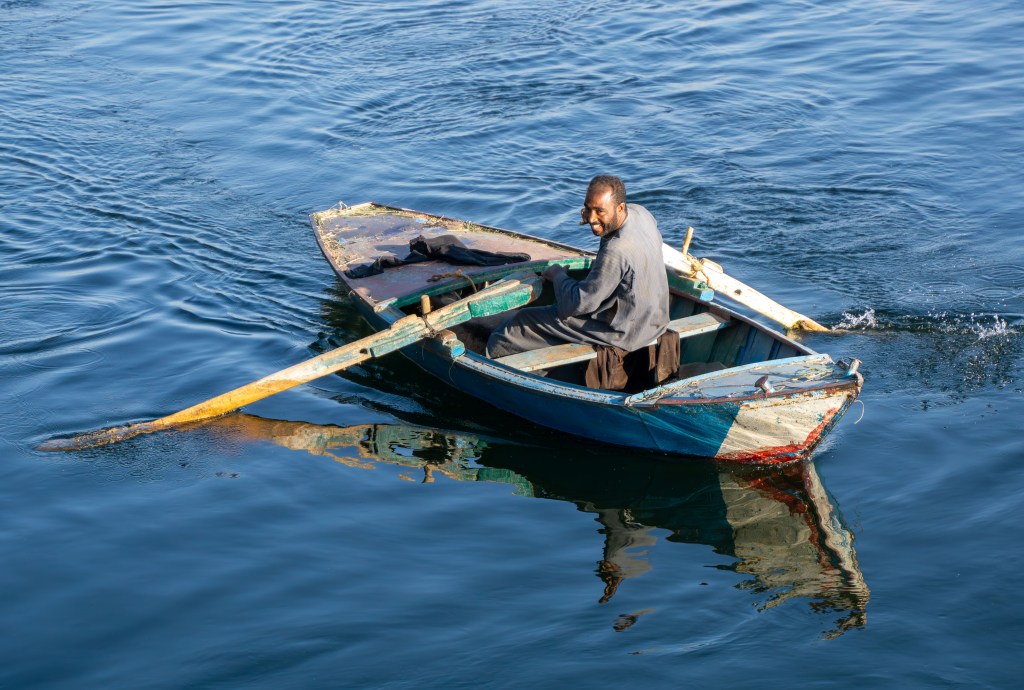
The herons, stilts, kingfishers, and small birds flitting through the trees and reeds along the Nile delighted me, as did the sunrises and sunsets. I was fascinated by the fishermen who rowed with clunky oars, usually two men in a boat: one young, one old. The old one handled the nets and studied the water, sometimes standing for a better view; the young one rowed, often in strong currents. I like to watch fishermen, perhaps because they remind me of my dad.
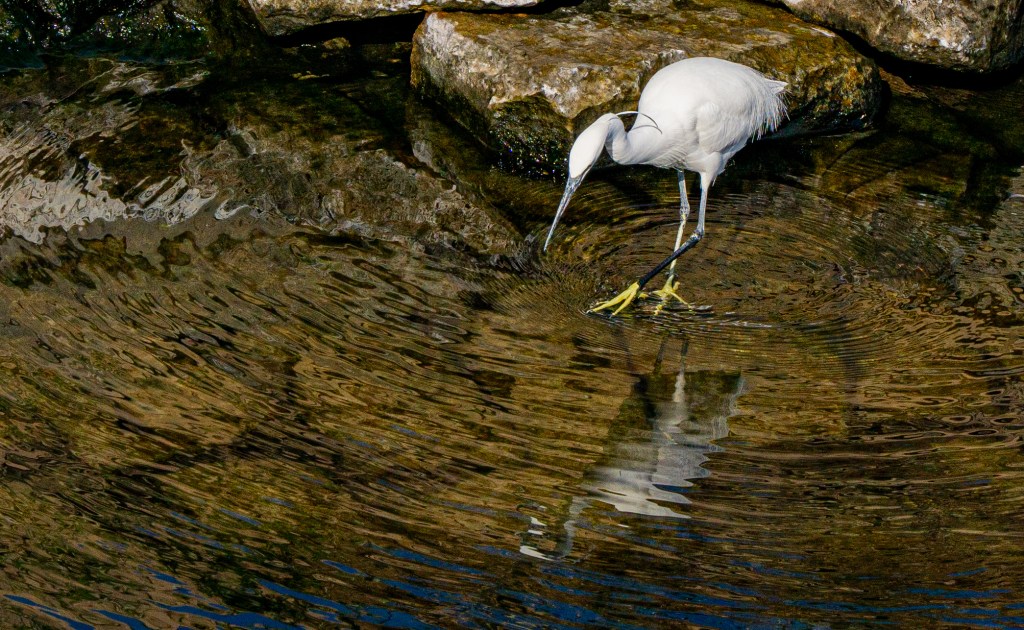
Snowy Egret on the Nile
Fisherman on the Nile

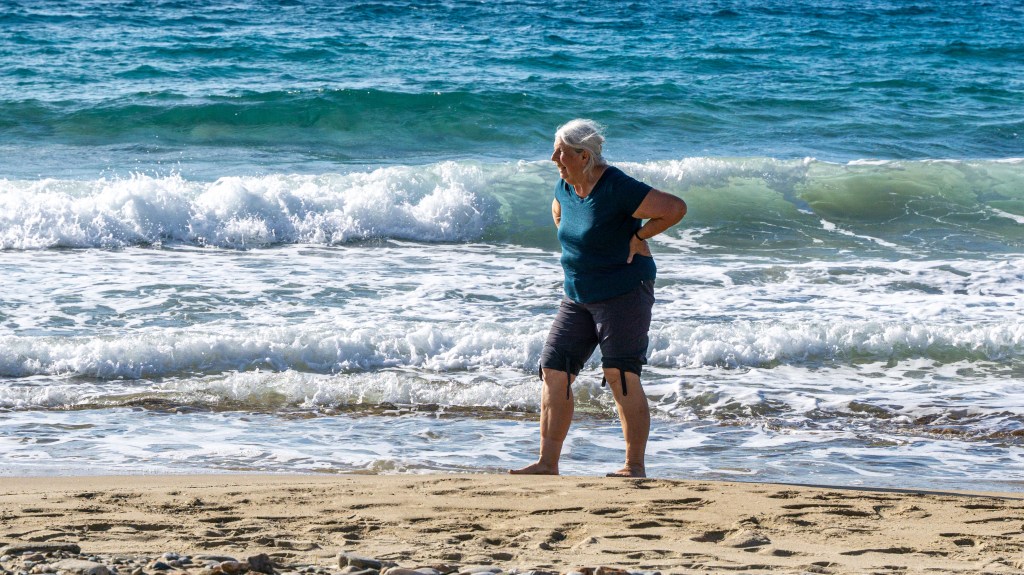
I loved the clear waters and brilliant pebbles on the Syros beaches, which reminded me of my childhood on Lake Superior. The autumn crocuses, struggling to bloom in the arid, rocky soil on the cliffs above the sea, brought back memories of autumn pilgrimages in France and Spain.

I photographed stones and waves on the beach and told Kent, “This is my happy place!”
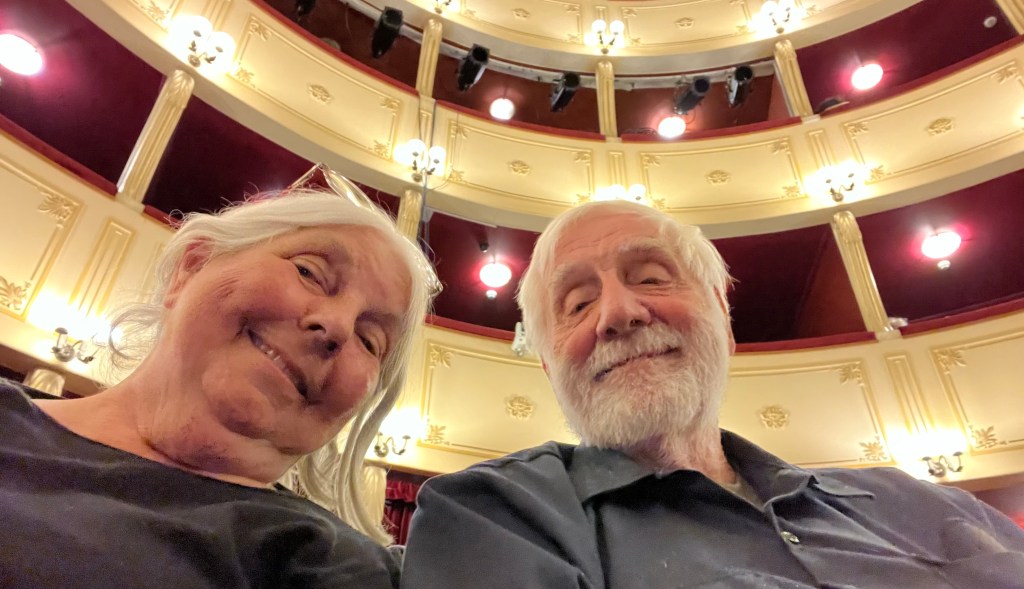
We took a ferry to Syros, seeking quiet after the intensity and crowds of Egypt and Athens. Our six-day visit coincided with the fledgling Syros International Chamber Music Festival, now in its second year. Violinist Pinchas Zukerman was the “grand old man” among the performers and organizers, but the younger musicians, their names hitherto unknown to us, were stellar. We attended all but one of five performances in the celebrated nineteenth-century Apollon theater, said to resemble La Scala.

I was touched by the participation of school children and the somewhat disorganized festival structure (performances started late, people wandered up and down forever looking for their seats, buying tickets was cumbersome, and people clapped in the wrong places). I  recalled chamber music groups from the University of Michigan performing in the school auditorium in my small hometown of Newberry, Michigan, when one affable female violinist slept on our couch and shared our small bathroom without complaint. My parents faithfully attended the performances, enjoying the rare opportunity to experience what my dad called “highbrow culture.”
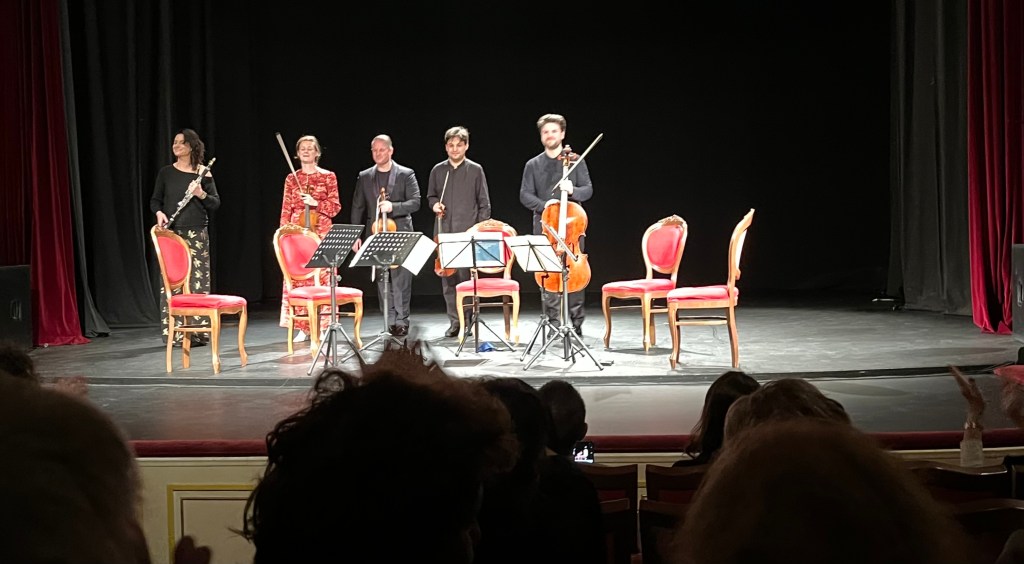
For information on the Syros festival, the music played, and the biographies of the distinguished musicians, see: https://www.meet-the-violins.org/en/events

December 11, 2024

In October, we met Rebecca Reynolds at an author event she shared with Kent at Albuquerque’s Books on the Bosque. Although we’d just met, she cleverly used Kent’s decision to run away to sea as an example of an individual choosing to make a momentous change in his life. When Iwoke up this morning to begin reading the book, I found the first chapter of Thresholds of Change (Denver: Connolly Fox, 2024, so inspiring I stopped reading and wrote the following:

I am captivated by Reynolds’ use of the metaphor of the chambered nautilus. The nautilus creates new spiraled chambers as it grows, sealing each chamber except for one thread of living connective tissue called the siphuncle. As Reynolds describes it, “A core life-giving line that provides ballast and connects us to all parts of our lives, even those we’ve left behind.”

 “The journey is what’s truly important.” Our experiences in life are not “over and done.” They are all connected.

As a pilgrim who sees my life as a journey, I like the concept of a living thread connecting all parts of my life.

I recall Tennyson’s poem “Ulysses.”

 “I am a part of all that I have met.” These words mean more at eighty than they did at seventeen when I first read them in Miss Dwyer’s English class. I remember Miss Dwyer not only for what she taught but for her enthusiasm and implied belief in the importance of her subject matter. Through the siphuncle, the presence of Miss Dwyer and many family members, friends, and mentors connect my past and present.

At Miss Dwyer’s urging, we chose the final words of “Ulysses” as our Class of 1962 motto: “To strive, to seek, to find, and not to yield.” (How many of you remember your high school class motto?) This morning, I reread the poem in tears because I, too, now look back “from that sad height” (Dylan Thomas’s “Do not go gentle into that good night”) and reflect on the meaning and purpose of life from the perspective of old age.

Perhaps we live to love, learn, and grow in preparation for whatever comes next.

The dear friends I’m losing with increasing frequency remain part of my life forever. Sometimes, like this morning, my memories of them emerge through that life-giving core when they are least expected and most needed.

We have returned to a different America than the one we left. As the chaos and my feelings of foreboding intensify during this week before Christmas, I watch, wait, and pray for light to come as the world turns and the sacred sun returns.

“Yet all experience is an arch wherethro’
Gleams that untravell’d world, whose margin fades
For ever and for ever when I move.”

“Come, my friends, ‘Tis not too late to seek a newer world.” – Tennyson, “Ulysses.”
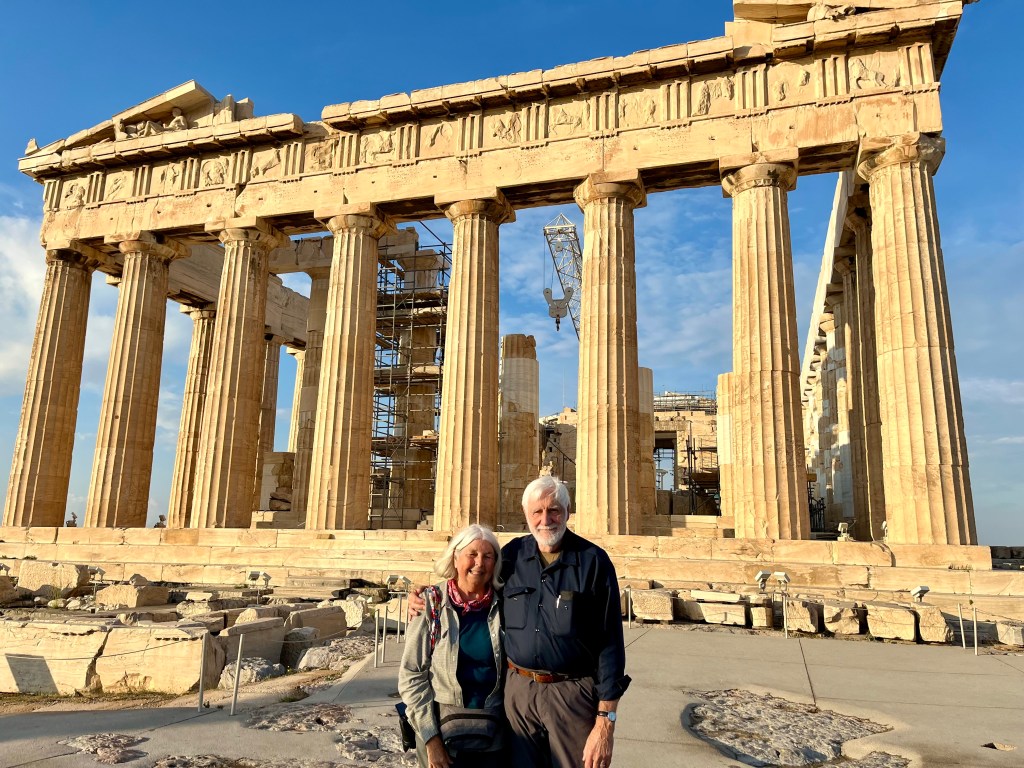
Linnea and Kent at the Acropolis early in the morning

Links to the poems:

Poems: https://www.poetryfoundation.org/poems/45392/ulysses

https://www.poetryfoundation.org/poems/46569/do-not-go-gentle-into-that-good-night

December 29, 2025

I wish you all light, strength, and happiness in the new year. And thank you to all who sent cards in the mail. I will write to you individually.

Holy Metropolitan Church of the Annunciation to the VIrgin Mary, Athens, Greece

Please also see our JacanaPress.com blog for news relating to We Ran Away to Sea, which to our surprise and delight has recently earned three awards .
Reflections on Mortality: Happy Birthday to Me

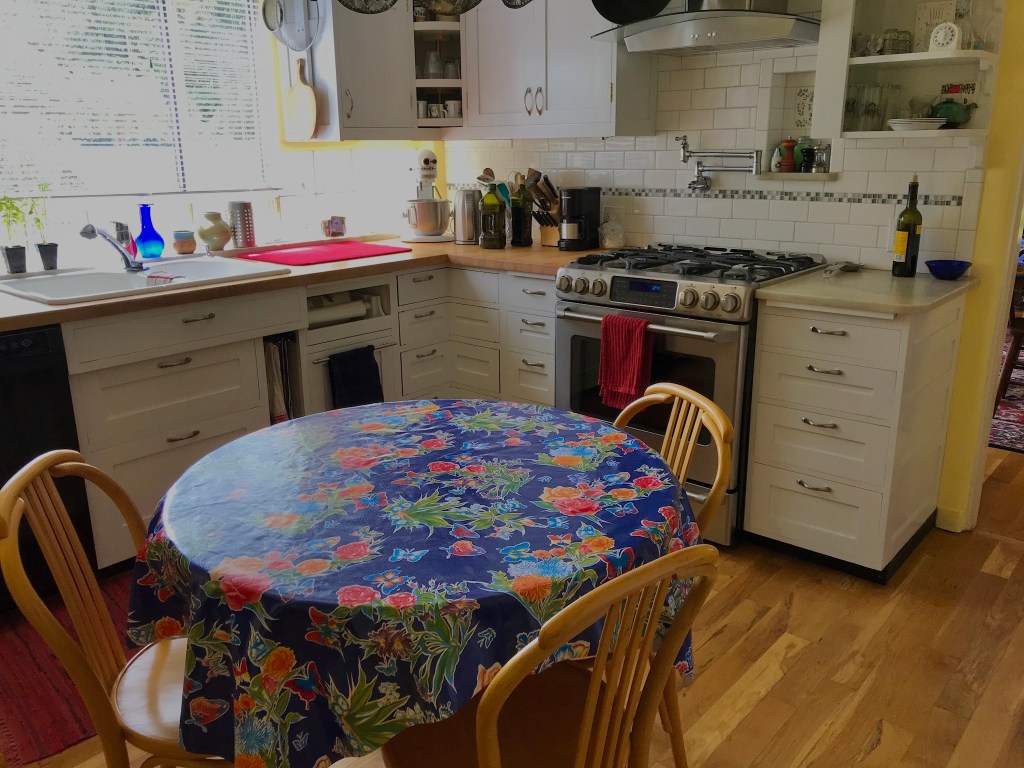
The Kitchen

May 19:

I sit in the kitchen this morning, thinking it may be my favorite room in the house. After years of indecision, we finally remodeled it, with Kent doing all the work.

While seated at the little round table at its center, I look at the lovingly crafted and designed cupboards — the lazy susan in the corner, the pullout-bin for trash and recyclables, the handy open-fronted drawer containing the paper towel roller with space behind it for an extra roll and dish towels. The under-sink drawers can be removed to access the plumbing (eliminating that dank, dark, hard-to-reach hole found in most kitchens). Also, under the counter beside the sink is a tall, narrow pull-out on which sits an antique ivory and red tin box from my grandfather’s house that holds dishwasher detergent, and above that, a nifty trio of towel racks on which to hang dish towels and washed recycled plastic bags. Above the drawers beneath the counter are wooden cutting boards that can be pulled out as needed. There are also vertical pull-out cupboards above and beside the refrigerator. Above the sink and in front of the south-facing window that looks out on the bird feeders and the spacious backyard is a light operated by pulling on a frosted glass knob at the end of a chain, so easy to reach just where it is needed.

May 29

I started writing the reflection on my kitchen ten days ago. It was the day after I’d had an echo-stress test on a treadmill and learned there is an abnormality in the walls of the left ventricle of my heart. Thus, I set about to contemplate my mortality. Yesterday, the day before my birthday, I underwent a nervously anticipated heart catheterization. I dreaded not only the procedure (although that was worrisome, too) but what it might reveal. I hoped for a small blockage that could easily be removed, enabling me to immediately run up hills like a twenty-year-old without gasping to catch my breath. But I feared that my arteries could be a complete mess and that I’d need a quadruple by-pass or worse. Neither of those scenarios unfolded. Instead, some problems will be treated with medicine, exercise, and diet, requiring some work on my part but no surgical intervention. I am grateful.

Today is my birthday. It is hard to believe I have completed seventy-seven years. I look back at childhood, adolescence, the college and young adult years, then marriage (later than most), two children, several careers, widowhood, adventures as a single person, and a second joyful, unexpected late-life marriage. Today would also have been my dear Ed’s 95th birthday and our 44th wedding anniversary.  He died just days after our 30th.

Last week I happened upon a Mary Oliver poem embedded in a beautiful ceramic bench on the grounds of the Harwood Art School in Albuquerque. It was not the first time I’d read this poem, but its closing lines, especially, spoke to me and seemed appropriate for this birthday morning when I am glad to have my body back. Thank you, Mary Oliver, and all the artists, holy ones, and mystics who help us live more fully.

“Tell me, what else should I have done?

Doesn’t everything die at last, and too soon?

Tell me, what is it you plan to do

with your one wild and precious life?”

—Mary Oliver, Poem 133: The Summer Day

Night and Morning: Being Tucked In

Ditchbank silhouettes

June 9, 2020

After last night’s brisk wind, the morning was fresh and cool as we walked along the ditch banks.  There is often a certain progression in my thoughts as I walk, not guided by me, but seemingly birthed from the motion of my legs, the swing of my arms, the pounding of my feet, and the quickness of my breath.

This morning, thoughts overflowed.  I thought of Philip Young, the gifted English literature professor from whom I took a class on Hawthorne and Melville long ago at Penn State.  One day he said, “I am rich!” referring to his fertile mind.  “I give you a footnote.  Others would write an article, but I have so many ideas, I can give them away in footnotes.”  I was feeling rich myself in those days, newly pregnant with my first child, but I had a hard time coming up with an original and compelling idea for my final paper.  Because I was a librarian, I had done endless research.  What could I say about one of these authors that had not already been said?  At last, pre-occupied and immersed in creativity, I had one small idea in response to Hawthorne’s short story, “The Artist of the Beautiful,” a story about the artist’s creation of a mechanical butterfly (which is smashed by the infant of the woman he loves) and the essence of creativity.  I no longer remember what my small idea was, (probably something about babies, butterflies, and nature versus human invention), but it was enough to satisfy Professor Young

So, this morning, I, too, was rich.  First, as we walked, I shared ideas with Kent about the memoirs of his life on boats, which I am editing.  Then I practiced, as I often do when walking, reciting (1) “The Lord is my Shepherd,” (2) “The Road not Taken,” and finally, (3) “Stopping by Woods on a Snowy Evening.”

At the turn-around point, looking over the green fields and t riverside trees to the volcano Vulcan, which along with several others marks the skyline west of Albuquerque, I did my usual standing yoga poses and stretches. It was while heading back, after half-an-hour of motion that, as usual, my thoughts began overflowing.  This is why I think walking is the cure for everything.

I thought about a friend who had gone back to the Catholic Church from the Episcopal church.  I wanted to ask her more about why, and I wondered what differences between the two might matter to me.  “Mystery,” maybe, and “Authority.”  The priest who presided at the Aquinas Newman Center on the Sunday following the dismissal of the Dominicans, had proclaimed, “Church was made for man, not man for the church.”  I despised those words and the top-down practices they represented.  I began weeping a few minutes into the service, left when it was over, and never went back.

Then I thought about the Compline (late night) service I’d attended via Zoom twice in the past week, and how comforting it was, like being tucked in by my mother and my aunts when I was a young child.  “Now I lay me down to sleep…” and “Good-night, sleep tight, don’t let the bedbugs bite.”   I wondered, did I do this for my children – tuck them in with prayers and give them a sense of security?  The words of the Compline service were comforting and soothing in this time of sadness, upheaval and uncertainty.  “The Lord Almighty grant us a peaceful night and a perfect end,” the service began.  And later:

Into your hands, O Lord, I commend my spirit.
For you have redeemed me, O Lord, O God of truth.
Keep us, O Lord, as the apple of your eye.
Hide us under the shadow of your wings.
— The Book of Common Prayer

I think I slept more soundly last night that I had in a long time, like a young chick sheltered under its mother’s wings.  The words and prayers, in the lovely language of The Book of Common Prayer resonated with me.  One of my favorite nighttime prayers, which we didn’t say last night, is from The New Zealand Book of Common Prayer:

Lord,
It is night.

The night is for stillness.
Let us be still in the presence of God.

It is night after a long day.
What has been done has been done;
what has not been done has not been done;
let it be.

The night is dark.
  Let our fears of the darkness of the world
and of our own lives
rest in you.

The night is quiet.
Let the quietness of your peace enfold us,
 all dear to us,
and all who have no peace.

The night heralds the dawn.
Let us look expectantly to a new day,
new joys,
new possibilities.

In your name we pray.
Amen.

I thought of Shakespeare’s “Sleep, gentle sleep, that knits up the raveled sleeve of care.”

Ha! I misremembered, conflating two different sayings, “Sleep that knits up the raveled sleeve of care,” from MacBeth, and “O sleep, O gentle sleep, Nature’s soft nurse, how have I frightened thee. That thou no more will weigh my eyelids down, and steep my senses in forgetfulness?” Henry IV, Part 2.

And, “Sufficient unto the day is the evil thereof.”  Matthew 6:34

Now, “Morning has broken, like the first morning.”  Eleanor Farjeon

My ideas have bubbled over.  I have a day’s work ahead of me, which I will tackle with energy gained from my walk and strength from my good night’s sleep.  When the day is over, I will no longer have “miles to go before I sleep.”  Night will one day come to each of us.