This was a hard day with lots of walking on paved surfaces, some on busy highways.
But, with Alain’s help we reserved a room in a chambre d’hôte for tonight.
I imagined a charming bed and breakfast with a hovering hostess, wallpaper, and our every need catered to.
Instead it was a room above a busy bar-restaurant. The listing said English spoken, but that was not the case. The harried owner was finishing serving the midday meal and directed us to the back of the dining room to some red-painted steep and narrow stairs, up which we trudged with our backpacks.
We found our attic room #2 with electrical cords running everywhere, a single bed and double bed with a small plexiglass shower and a sink in one corner. Toilet in the hall. We got connected to WiFi, figured out how to turn on an electric heater and we’re now actually quite comfortable.
Alain arrived after we had taken a short walk around the town. I also managed to reserve a room at the Hotel du Commerce in Guerigny—an 18km walk from here tomorrow.
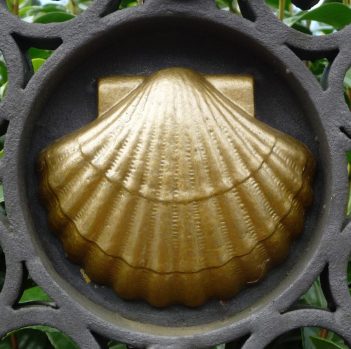
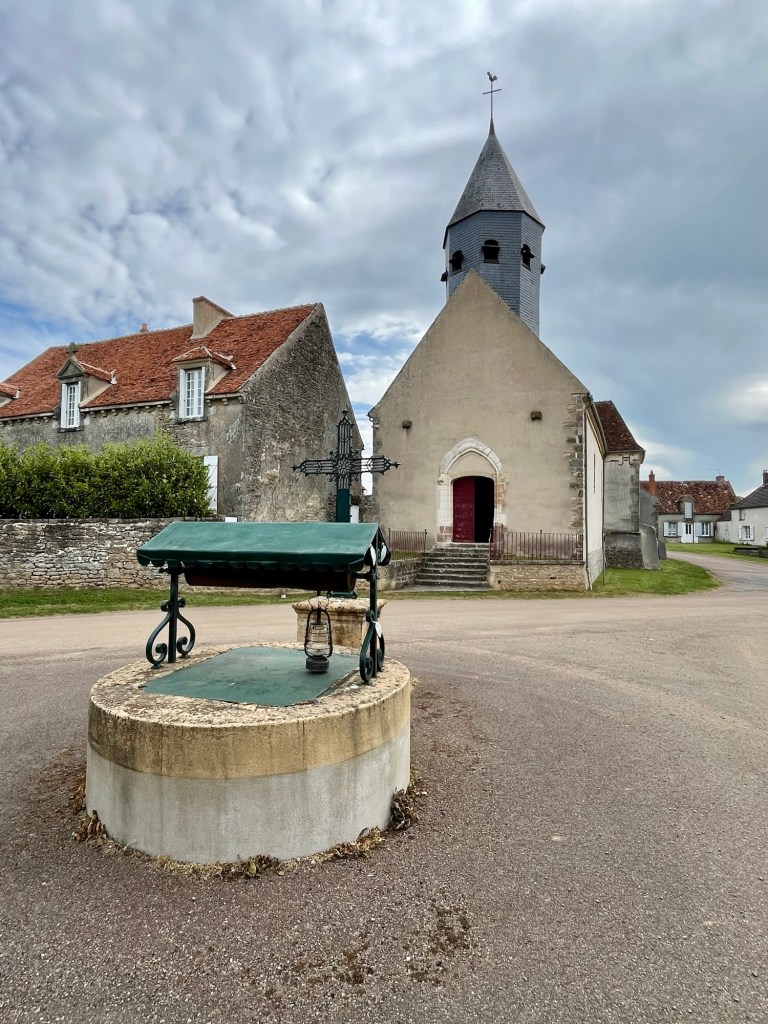
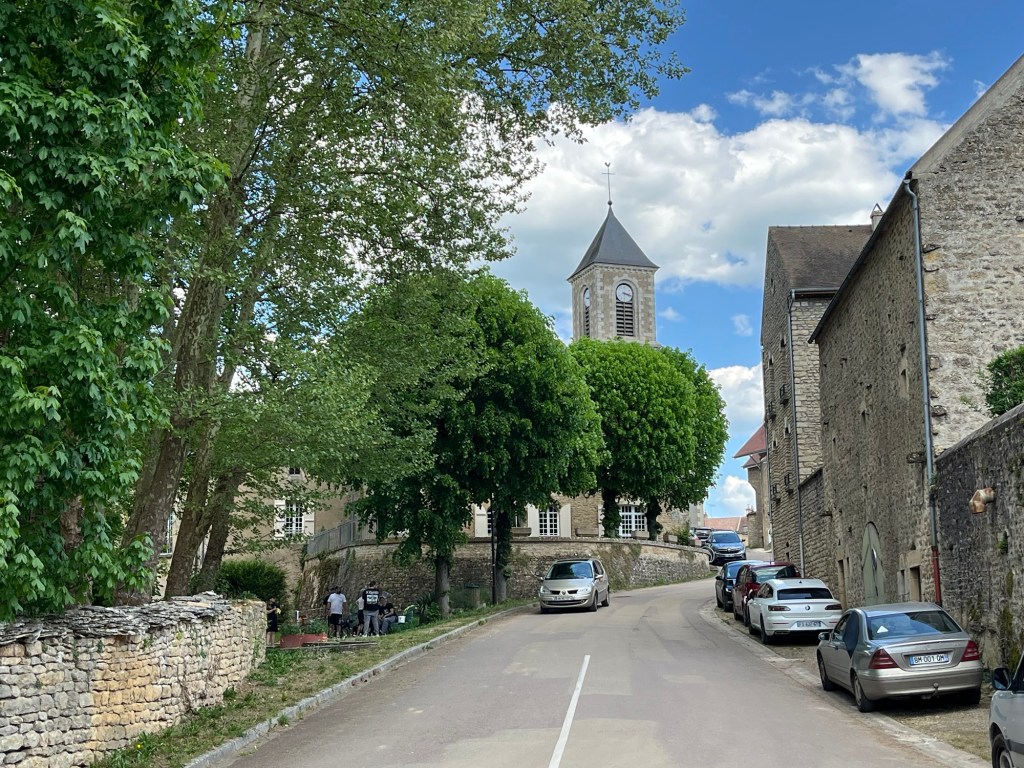
Highlights of the walk. Seeing a great white egret fly from a pond, finding a bench to sit on by a bibliothèque du lavoir, decorated on the outside with strings of multi-colored scallop shells, and with books filling the inside arrayed around the pool of water. Then the church in the lovely village of Moussy.
We also met three high-powered German walkers who walk a week of the Camino each year.
During long long straight stretches of highway I prayed long, angry prayers, thinking I was suffering walking this road out of choice, while many are walking even harder roads, and not with fine backpacks, boots, and money and credit cards in their pockets. We must be such a disappointment to a loving God for not taking better care of the poorest of those among us and pursuing money and power rather than loving each other. There was much more, of course.
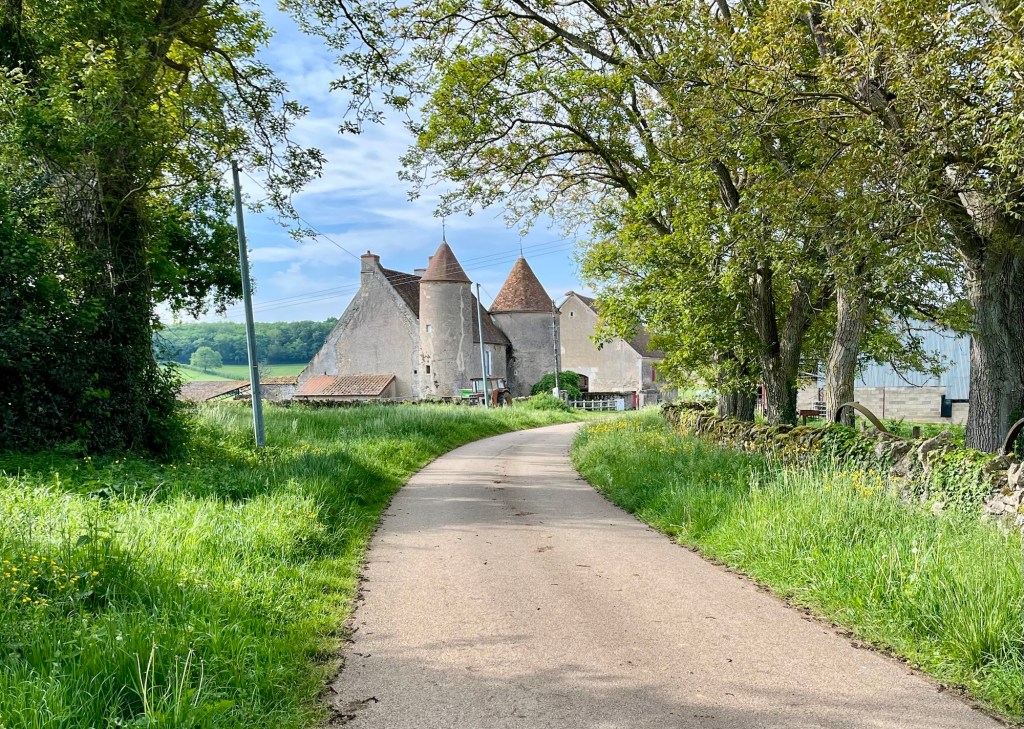
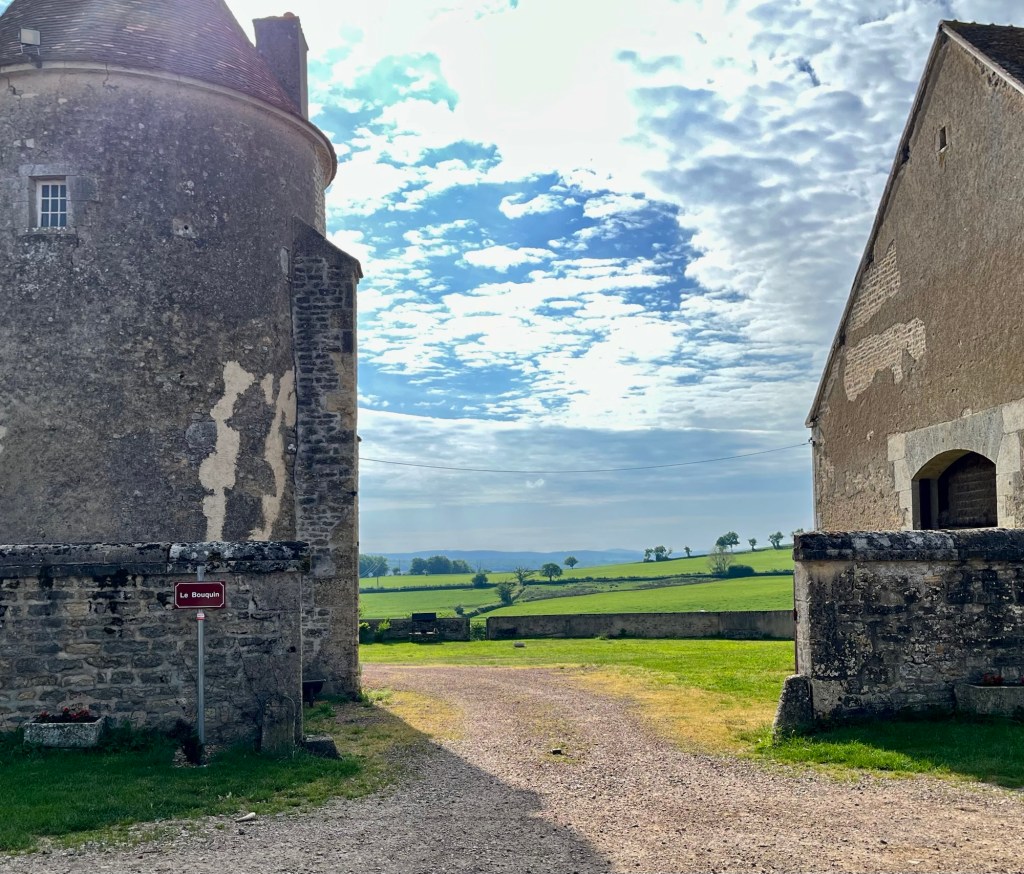
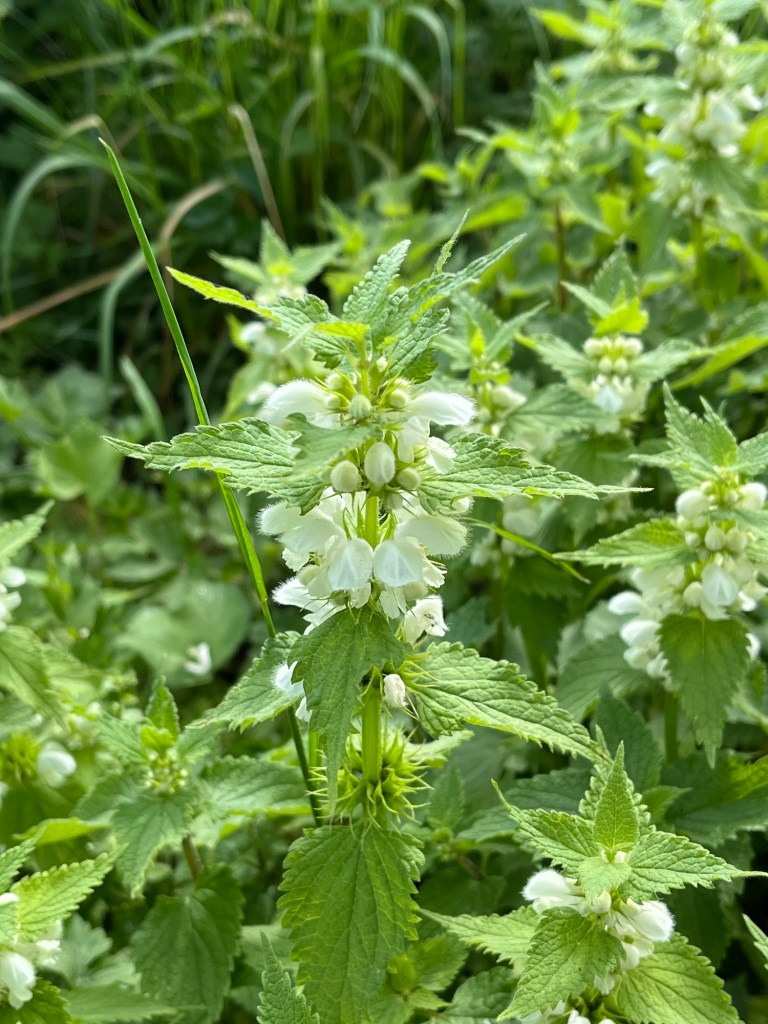
Favorite farm along the way.Le BoquinNettle flower— we ate nettle soup at L’esprit du Chemin
We’re in a large municipal gîte adjacent to the town hall, with two Netherlanders who walked in one day what we did in two, a bicyclist, and Alain. There is no heat and it is cold!
There’s a kitchen, one bathroom that fortunately has a nice hot shower that took me forever to figure out how to turn on, a stove and fridge and a little grocery with very limited hours and stock right next door. Fortunately we were able to buy a couple of beers, some juice, yogurt, cheese and bread. Oh, and 2 eggs. There is nothing else in the town, or anywhere for miles around. We ate what was left of the generous sandwiches last night’s campground made for us.
Our room with Kent sleeping City Hall view from our windowAnother window view from municipal gîte in Saint Révérien
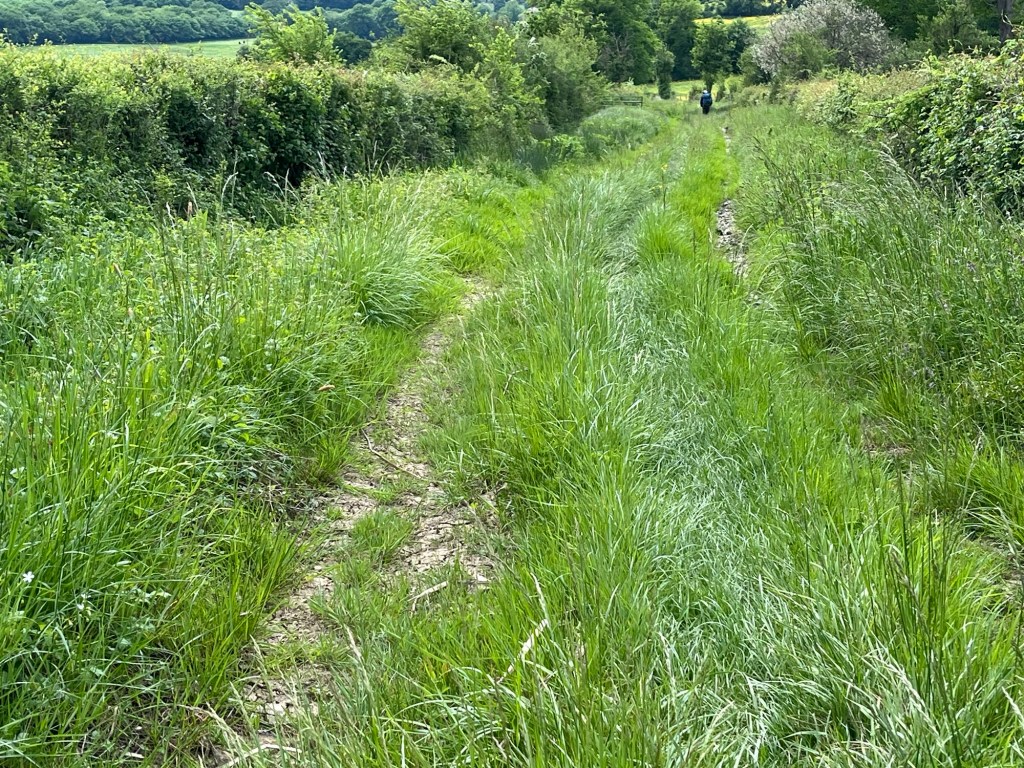
More beautiful scenery today. Lots of not too steep or long ups and downs, and a bit too much pavement walking, although on empty country lanes. Not a singe shop, bar or place to get water. Fortunately we had what we needed.
So far, this has been the most unpredictable Camino ever! I’ve tried booking a chambre d’hôte for tomorrow night in Premery, the biggest town so far, but it doesn’t seem to have a lot of options either.
We had nice conversations with the Dutch walkers, and Alain was able to translate the stories told by the woman who came to take our Euros and stamp our credentials.
We’re certainly living a simplified life in very quiet, uncrowded places these days. I’m sure traveling through this area by car would be quite a different experience. The cold weather is great to walk in.
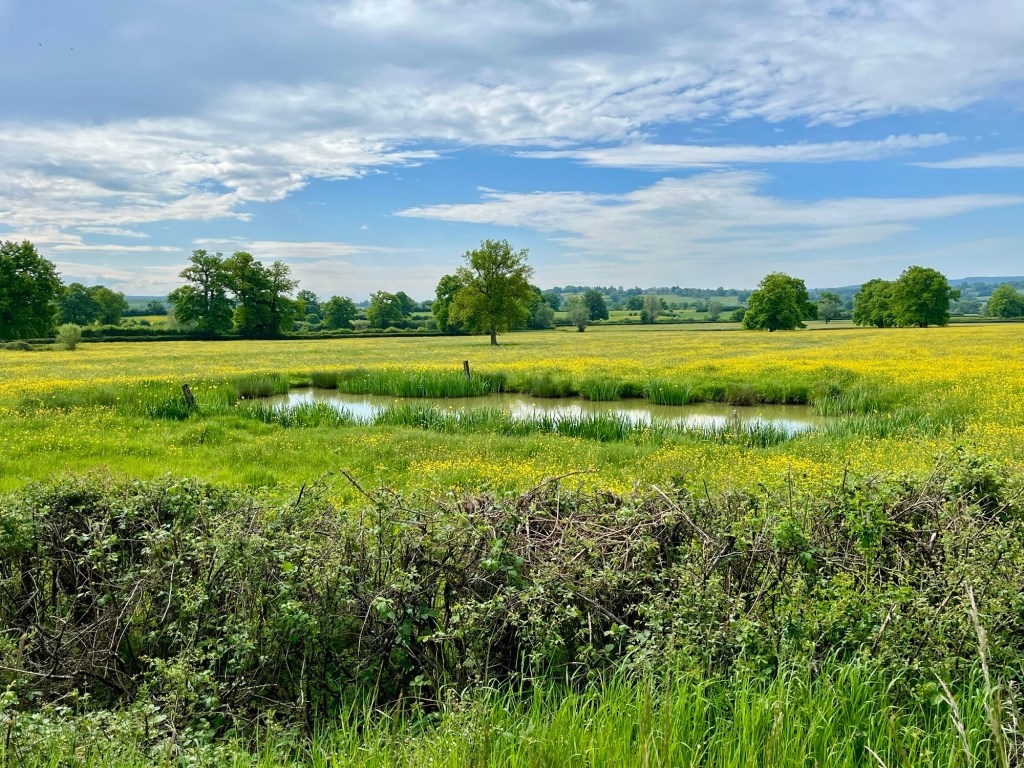
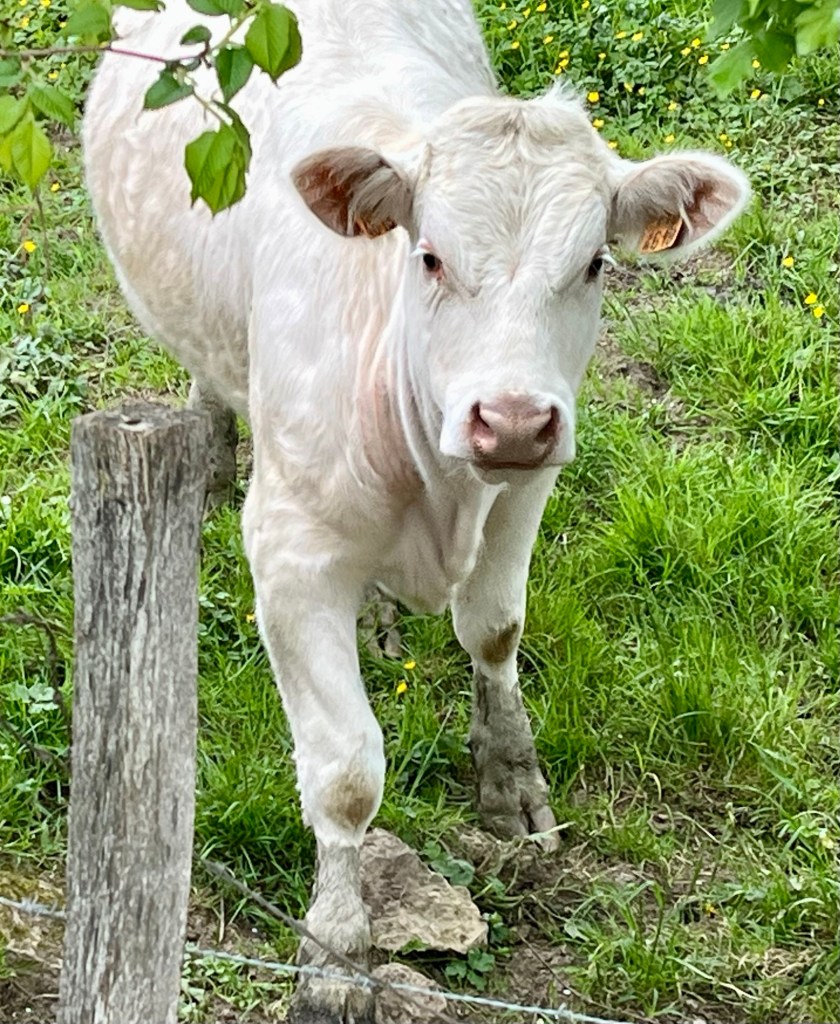
We saw a small red fox in the low marshy spot just before we climbed up here last night, heard many birds and spied our first magpies of the walk. We’ve encountered lots of white cows who eye us with great curiosity, a runaway lamb, and two horses today.
Who knows what tomorrow will bring?
Curious cowHeart❤️BarleyThrough tall grass and marshy spot
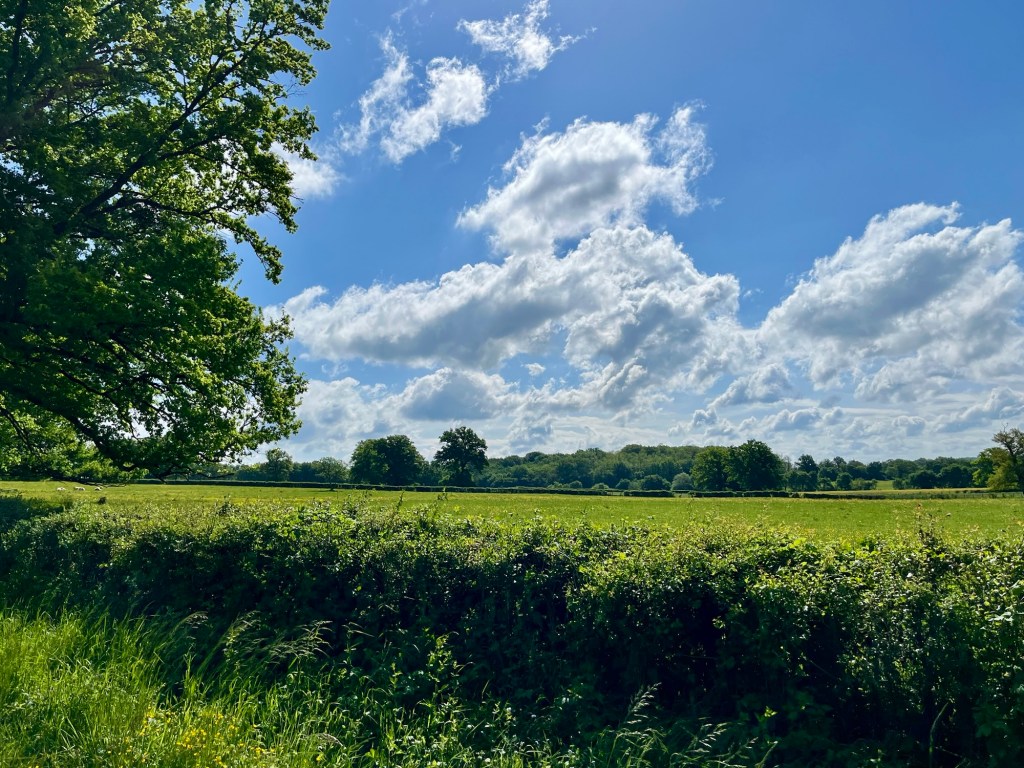
Today started out well with bright blue skies, fluffy clouds, and ups and downs through picturesque tiny clusters of houses. It was perfect weather for walking.
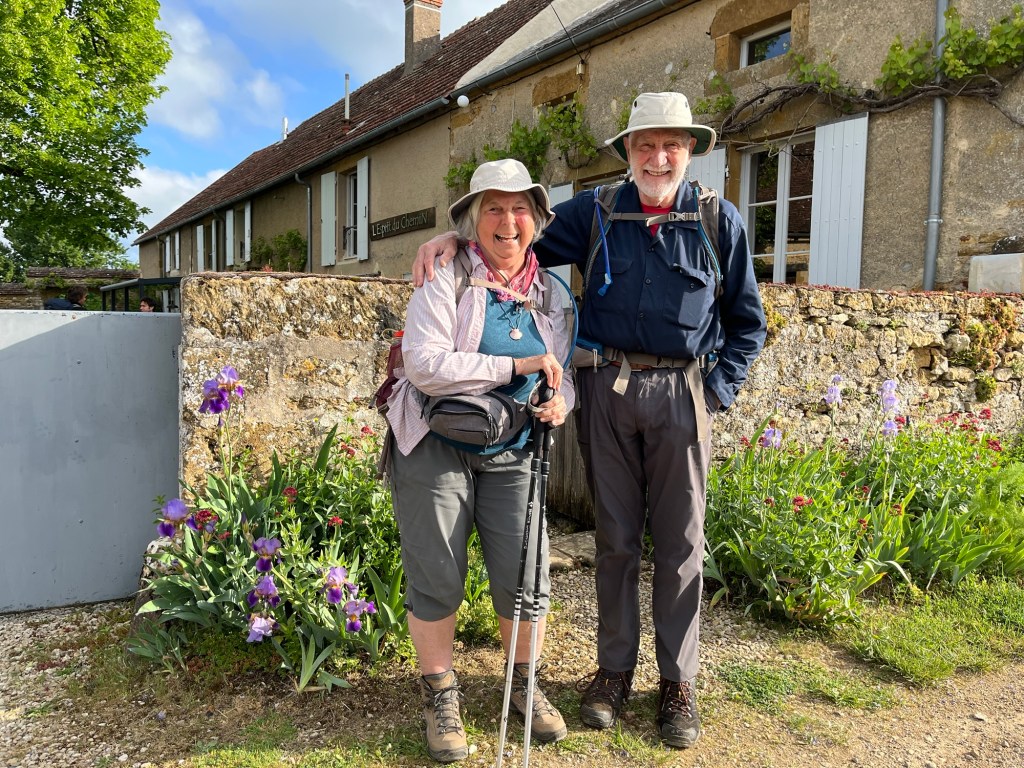
Saying goodbye at the lovely L’Esprit du Chemin this morning.Gorgeous clouds
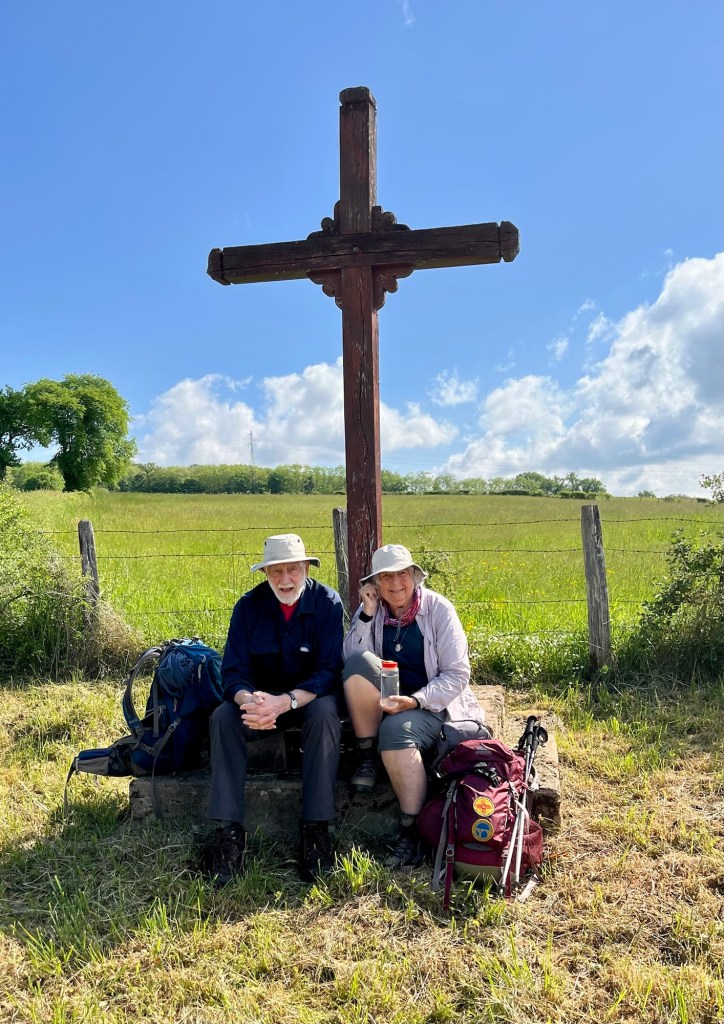
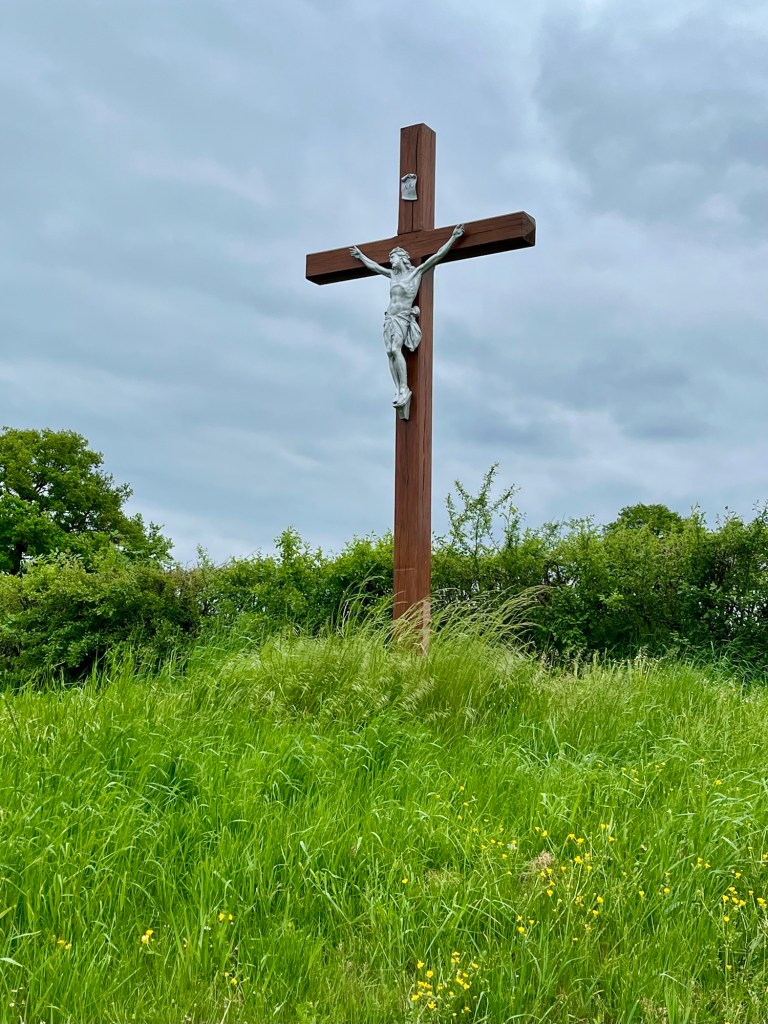
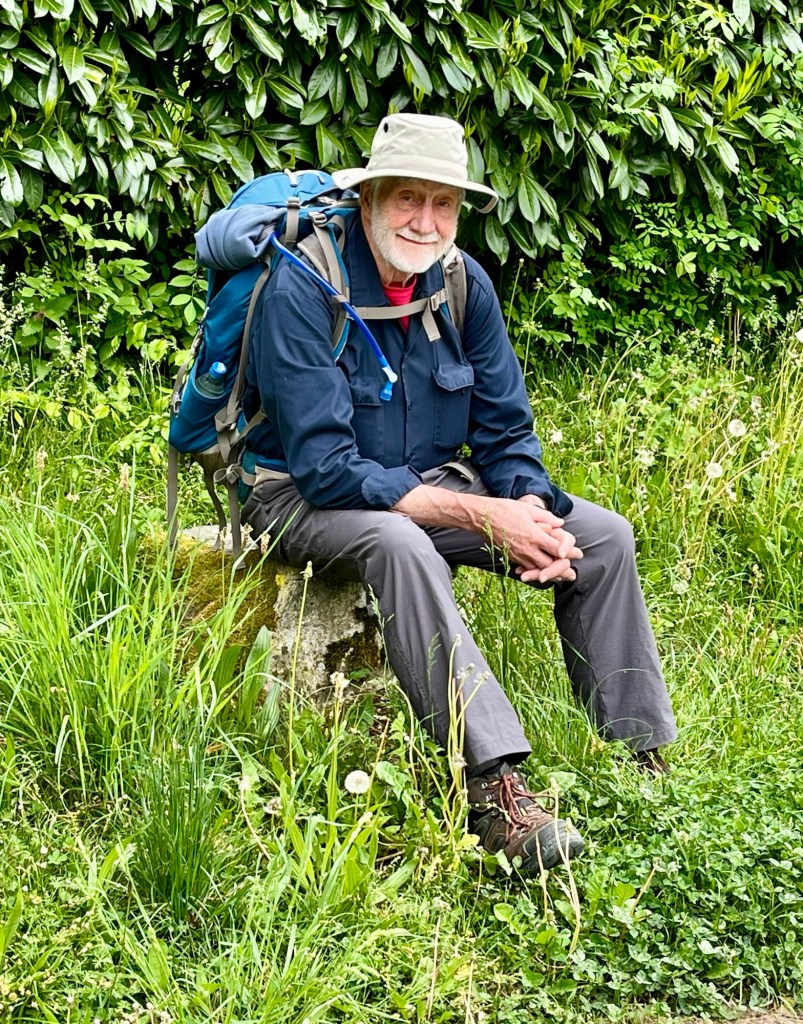
We took a break on the steps of a roadside cross. Alain came along as we were sitting there and took our picture.
We were dragging a bit by the time walked into Corbigny, the biggest town we’d been in since Paris. We anticipated restaurants and shops but although there was some activity we were disappointed. Lots of shops were closed, some because it was Monday, but some seemed permanently closed. We found a little restaurant, Cafe Didine, open, with a choice of chicken or tuna. We both chose chicken, but then were informed there was only one serving left, so I let Kent have the chicken and I ate tuna in a yellow sauce.
By the time we finished lunch the sky had grown gray and the wind picked up. We found 2 ATM machine and got more Euros, so we were relieved about that.
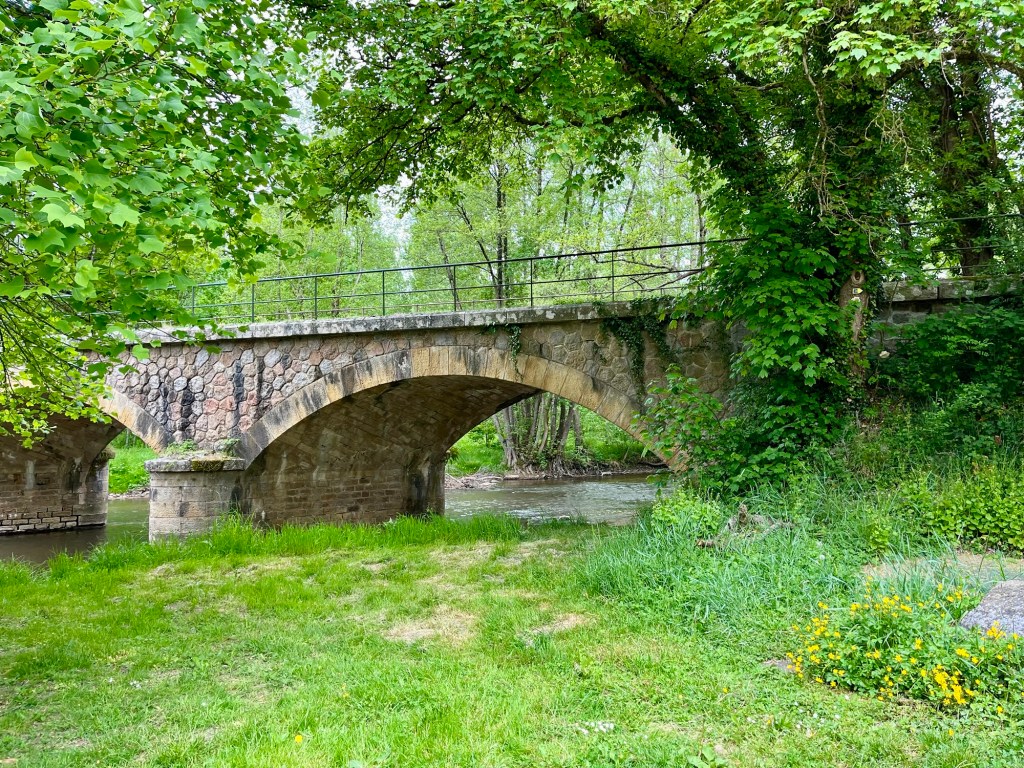
Dark sky and wind picking up behind crucifixBridge over the Nivernsi Canal
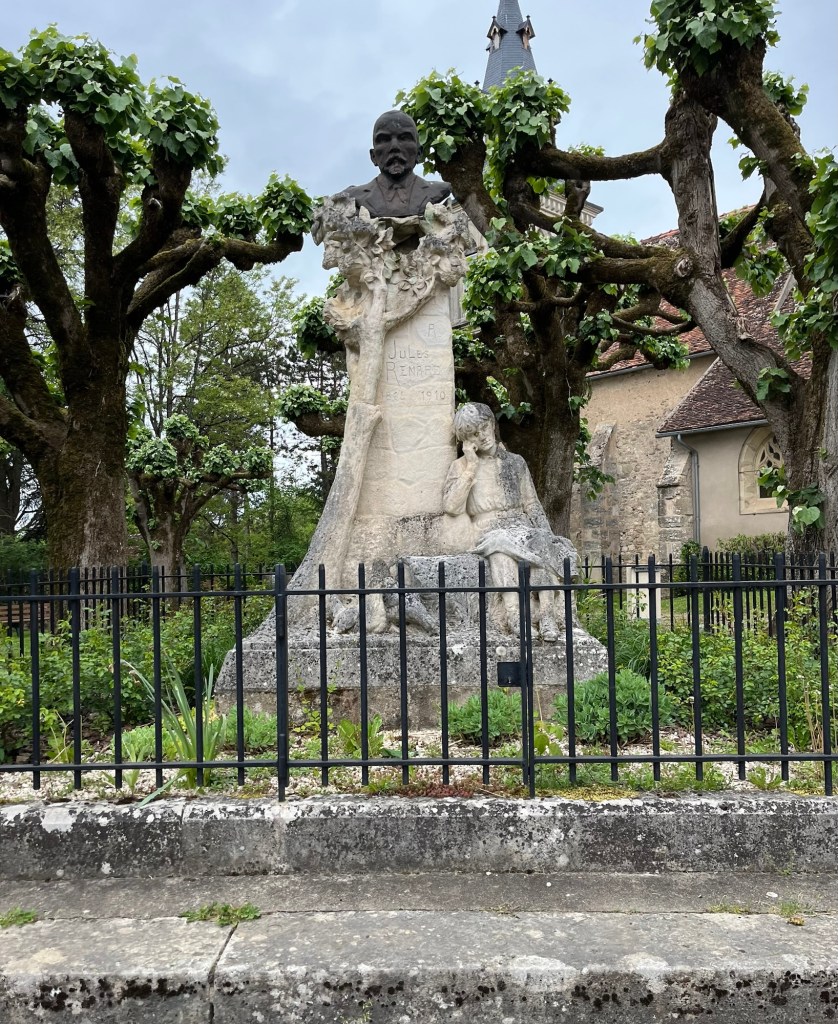
I felt quite refreshed after lunch, but Kent was lagging. We walked the old road to Chitry le Mines, birthplace of writer Jules Renard, whose work I don’t know. There was a plaque about his birthplace and a series of sites relating to him.
Monument to Jules Reynard
I enjoyed walking the abandoned old road, rocky and high above the new one where I could see cars whizzing by. I imagined what it would be like to bounce over those rocks in an old car. I decided I like neglected old places going back to the wild.
At the edge of town we crossed the Nivernais Canal, with many houseboats, but I guess we will not be walking along it.
Toilets and showers are a bit of a walk away and pretty much open air. Our little cabin has just two single beds, a shelf, a window in the door and a towel rack heater—so not quite the cozy bungalow I’d envisioned. I suspect if it was about 20 degrees warmer, I’d feel differently and enjoy sitting.outside.
Temp is 54 F, but with wind it is said to feel like 46. We did have an OK dinner with Alain in the little bar here. Tomorrow we’ll be in a municipal gîte in Saint Révérien, a 16k walk with no shops or bars along the way and a small grocery near the gîte. I hope it’s a pretty walk.
Getting Lost in a Sudden Downpour, but All’s Well with a Fine Ending
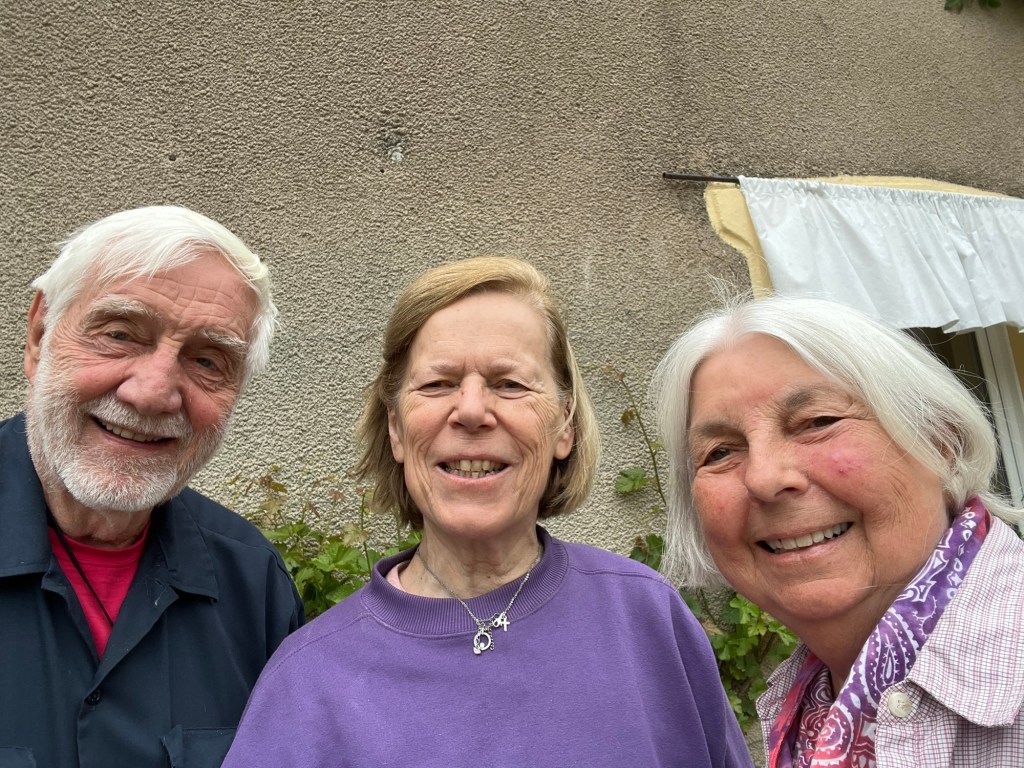
Kent , Chantal, Linnea
We had a lovely visit with our host Chantal this morning, and set off in high spirits, this time carrying plenty of water. The first part of our walk was gradually uphill through old forests filled with masses of spring flowers.
Masses of flowers
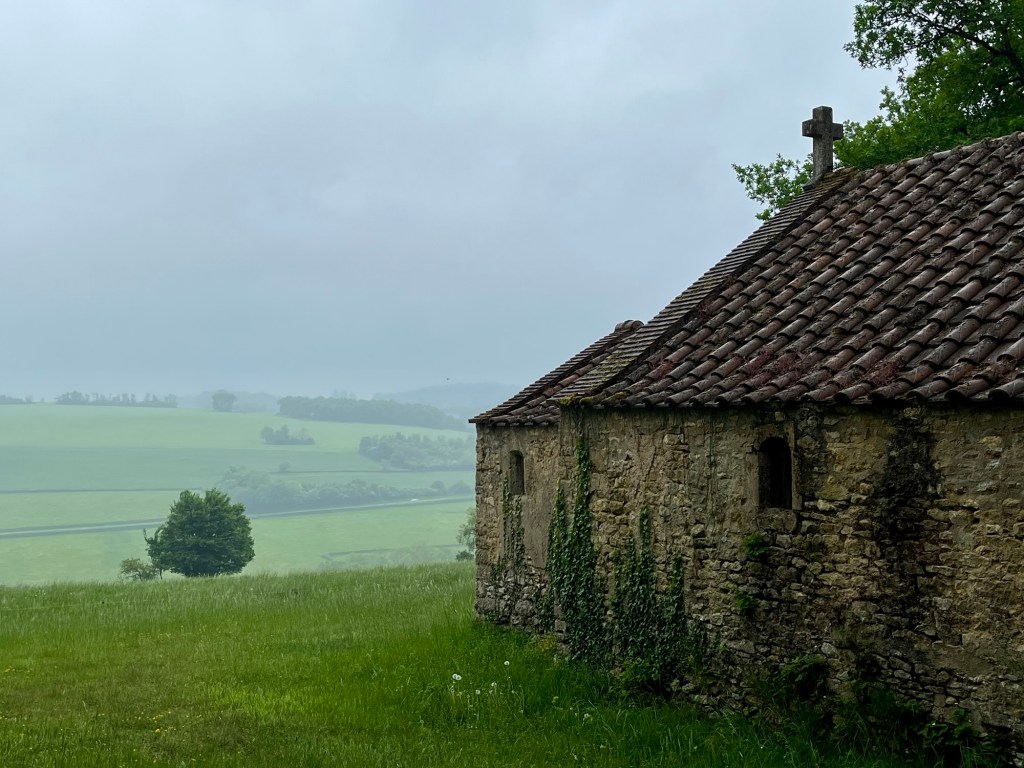
We rounded the Chateau at Bazoches, and probably should have continued on the old Roman road. Instead we descended steeply into Bazoches, missed a turn and retraced our steps descending more and then ascending through more woods to a deserted Chapelle de St. Roche.
kentSt Roch Chapel
Then down to La Neuffontaines where we shared one of our sandwiches at a picnic table bedside the road across from an old lavoir. Feeling quite proud that we were making good progress, we should have been cautious. After all, pride comes before fall. We left the village with its abandoned church and climbed up out of the village. A woman working in her garden wished us “Bon Chemin” so I was confident we were on the right track. But Kent said, ”We shouldn’t be following a paved road out of town.”
We came to an intersection with a cross and dirt tracks crossing the road marked by a Compostelle marker that pointed at an ambiguous angle.
I decided we should turn right onto the dirt track, which we did, seeing nary a marker along the way. We came out on another road, just as the map showed, but no markers in sight,
“Look at that big cloud!” We headed to an intersection with lots of signs, none of them for the Camino, and none with any names we recognized.
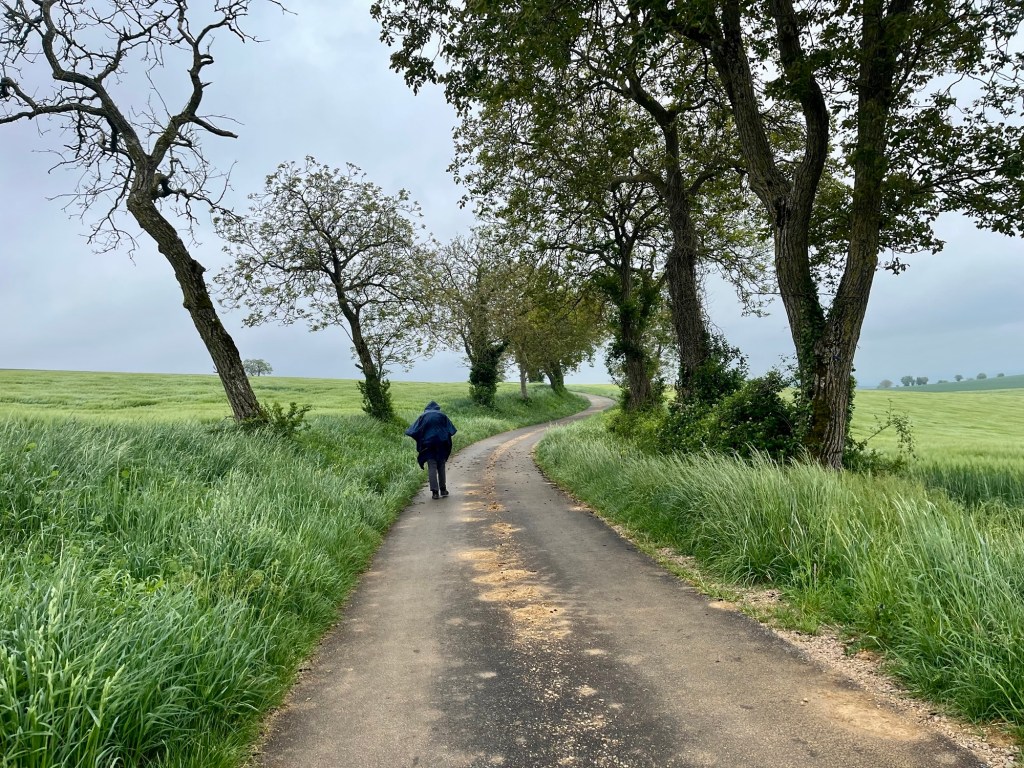
What to do now? We studied our maps and I tried to pull up other maps on my phone. We hadn’t figured anything out when the sky opened. We grabbed our ponchos and struggled to pull them on in the wind and rain. A scrawny tree offered no protection.
What to do? I waved down a passing car. It looked like a middle-aged woman and her mother.
“Nous sommes perdue.” I said in my impeccable French.
“Where are you going?”
“Le Chemin de Compostelle.”
They shook their heads. No idea about that. I tried to think of names of places ahead of us. They were all tiny hamlets no one would have heard of.
Finally I remembered Corbigny! Meanwhile we were getting wetter and wetter, my hands were so cold and wet I could not bring up anything on my phone, and rain was pouring through their car window. Corbigny was behind them, they told us. They tried hard to be helpful, but we didn’t even know what to ask. Bless them!We let them go, and Kent suggested we walk back to Neuffontaines to try to find where we went wrong. As we walked back on the road that we hoped would take us there without cutting back through the field, which would now be muddy; the rain stopped.
We returned to our sodden map pages. I gave up on the phone. Without the rain pounding us, we could study the map.
Kent guessed we should return to the road where we’d met the car and continue in the direction the car had been going. There was a church on top of a hill we’d seen from miles away.
“We need to be on the other side of that hill,” Kent said. I could see he was right. We’d turned off the road out of the village too soon. We realized that the faint gray lines on the map meant paved but unmarked roads. We’d been on the right road in the first place. Sure enough another km or so along the D142 highway, we came to the track we should have taken from the first road out of the village, and there were Compostelle signs!
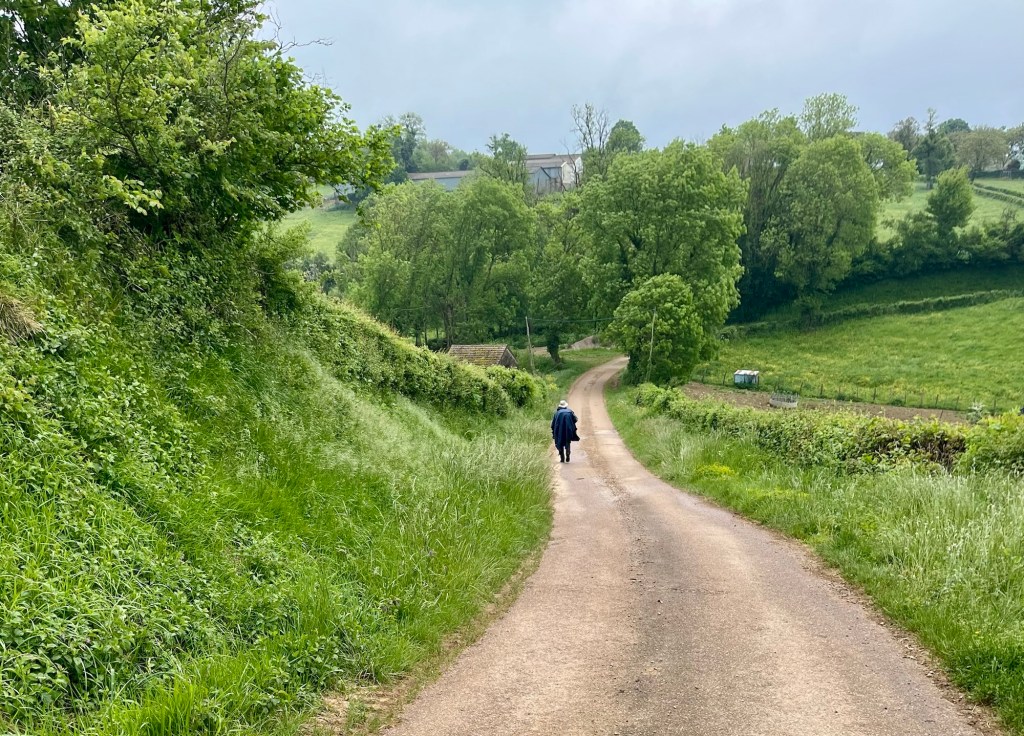
I was relieved. And humbled. We walked around the high promontory, and the sun almost broke through. When we passed a weathered cross surrounded by blue and yellow irises, I started to cry, grateful for Kent and grateful we were on the right path. The scenery was spectacular. we passed through and near almost empty villages, and found Compostelle markers at every turn, through steep downs and ups, curious cows welcoming us at the top of a long climb and one snorting bull who charged to to a fortunately strong fence as I passed by, my blue poncho blowing in the wind.
Now we are spending the night in the loveliest gite imaginable and we even have our own room with a large double bed, sheets and a warm comforter. And who else is here: Alain, and another dozen people. Dutch, French, German, many English-speaking. We had a delicious communal dinner at a long table, all much better than we deserve. There is even WiFi. Plus I was given additions to the Organic Maps app that shows where we are and where the camino roads and lodgings are. So we should get hopelessly lost again! Merci!
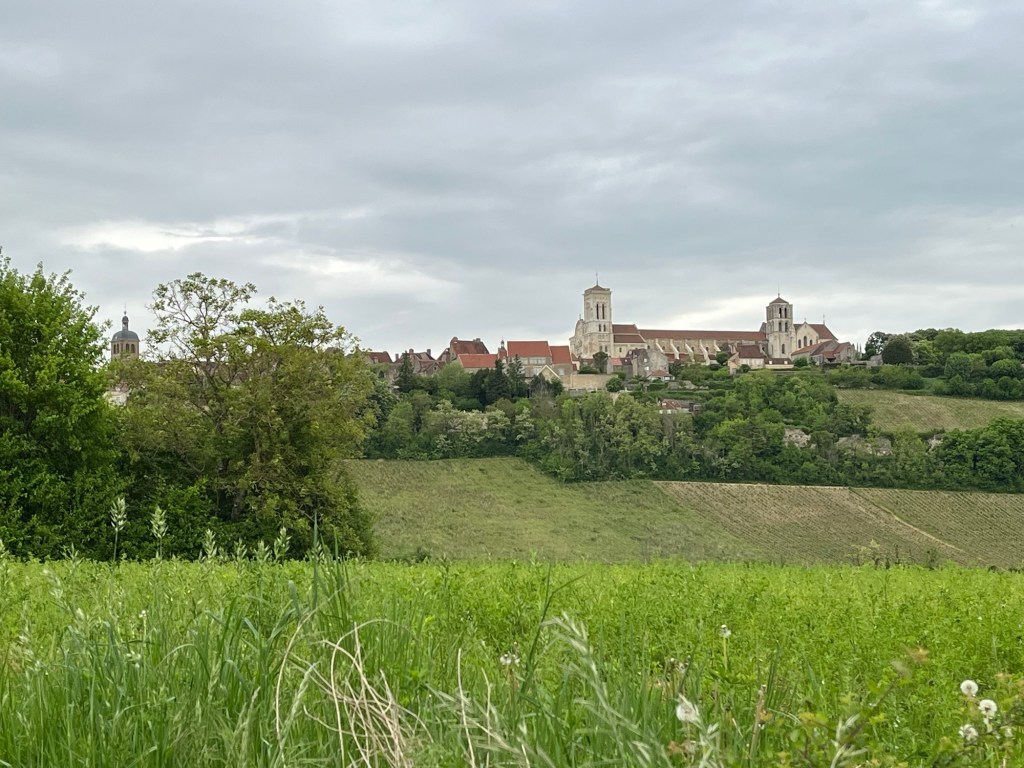
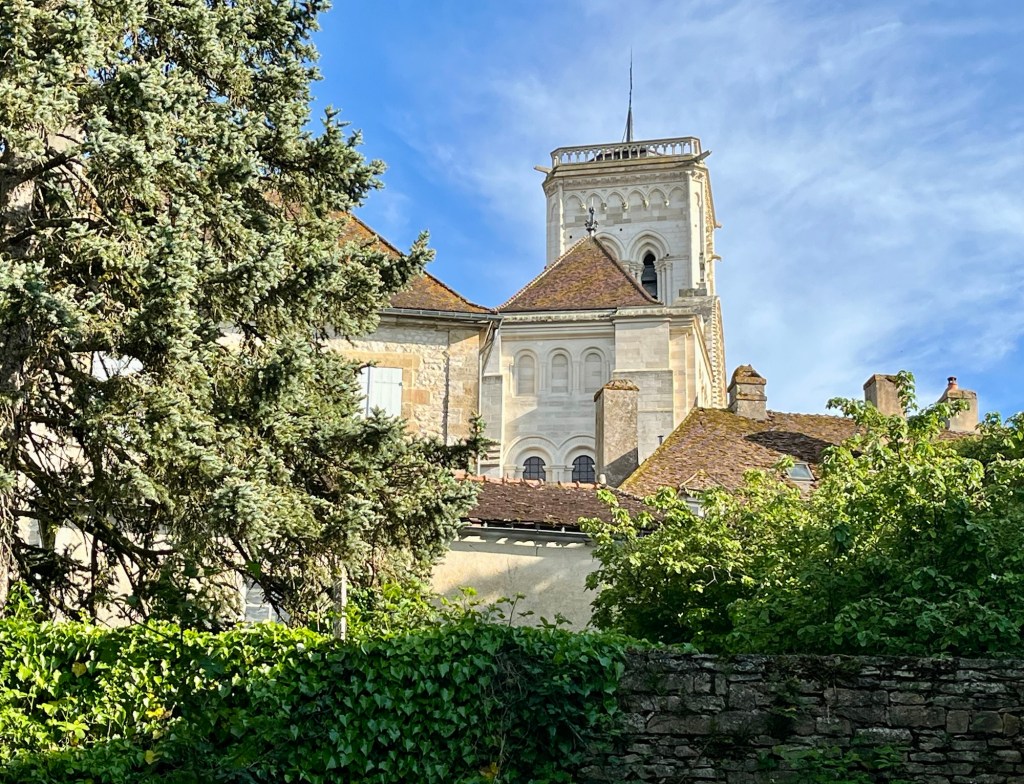
It’s been an interesting day. We left Vézelay at 7:30 am, walked down the hill and took a side path to St. Père. The path descended through open fields, with views back toward Vézelay the revealed the whole village and its escarpment. One thing did not go right this morning was that the sole ATM machine for miles around, was not working.
Our Capital One account limits us to $300 per day, which does not last long if we are staying in places where we need to pay cash, which will be the case for the next four nights!
I spied a spire that appeared to be growing out of a field. Was it some kind of triangular piece of farm equipment?
No, it was the spire of the historic church of St. Pere (named on the basis of local pronunciation of St. Pierre.
We walked to the church, found it would not be open until 9, another, 45 minutes. I could tell from my online map (Organic Maps) that there might be a bar and hotel on the main road a short walk away. Then an elderly woman in a red car pulled up,rolled down her window, and motioned did we want to eat? We said “oui,” and she pointed in the direction we were walking. Sure enough we found a bar and hotel, but no signs of the Vival (small grocery/convienne type store) that should have been there, too. The bar had orange juice in a bottle, not the hand-squeezed kind you get in Spain, but we were happy to have it. There were a lot of women with big backpacks there, too, but we would never see any of them again.
After back-tracking to see the church, then returning to the main road again and crossing the River Cure, we veered off onto a small track that led us along the river, then up and down across open fields. We’d had a few drops of rain earlier, but now the sun came out and it was hot. It seemed like a long way before we spied some buildings, and at last came to a road. And there at an intersection sat Alain, whom we’d first met at the Bercy train station in Paris, and again yesterday at mid-day in Vézelay. He had not continued to Bazoches that day, but stopped, perhaps at St. Pere.
Less than an hour later we encountered him again at another intersection. A fancy restaurant was nearby, but not yet open. We had not filled our hydration packs and our water bottles were getting low. Then we encountered two very fit-looking women we’d shared our dorm with and sat across from at breakfast, they were walking toward us, looking for the path. Alain had disappeared down an unlikely looking track that went steeply down. Kent and I decided that was the way, but the two women continued back the way we’d come, not convinced. We never saw them again.
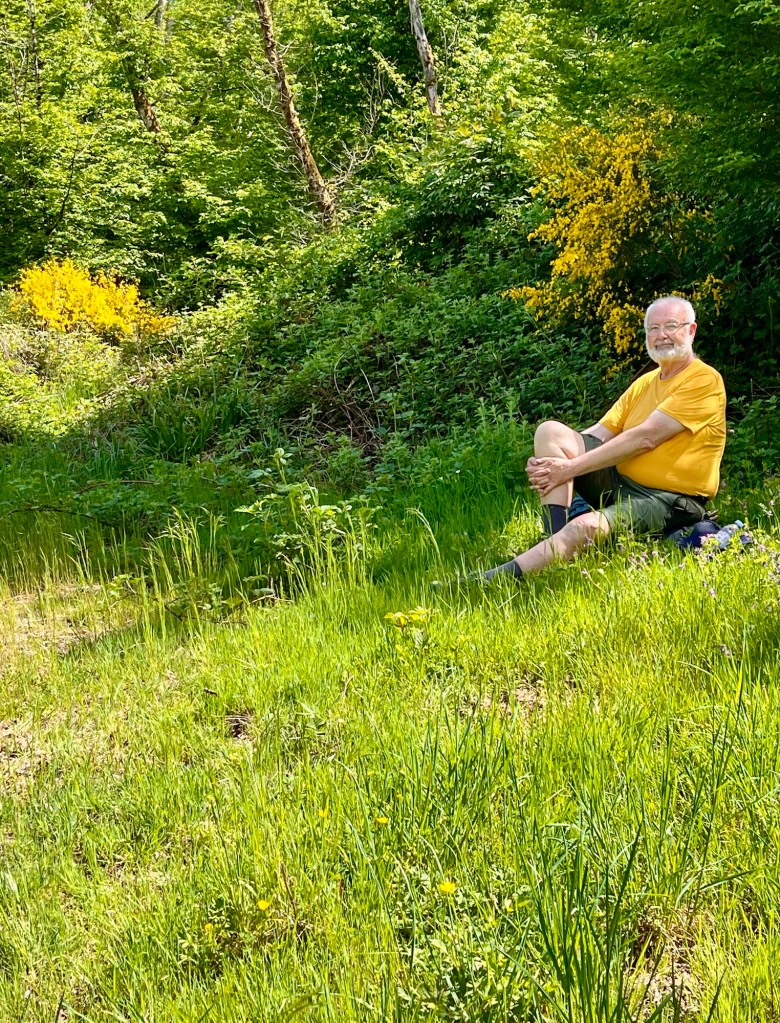
The track began to climb, sometimes steeply and muddily, through deep woods. Kent spied Alain ahead, and at one point a runner zipped past, making me jump in surprise. Finally we came out of the woods onto a gravel road lined with brilliant flowers. And there was Alain, who looks about our age, taking a break. I snapped his picture among the yellow flowers in his yellow t-shirt.
Then we came to a magnificent chateau, that also was a gite and campground. But we had reservations with Mme. Chantal Perriot. We had her address but were uncertain which branch of an intersection to take. We asked a man standing in his doorway who informed us Mme. Perriot was expecting two Americans. He also invited us in to refill our water.
We didn’t know quite what to expect at this lodging, but we have a little cottage to ourselves with kitchen and bath surrounded by roses and wisteria and with sheep next door. Chantal Perriot has been delightful, bring us delicious fresh bread and cheese, leaving us withheld microwave dinners fresh strawberries, apples and pears and cheese, and a fridge stocked with beer and coke because we told her we have no food.
We’re quite comfortable here, and with her help have a place for tomorrow night. She’ll give us breakfast and sandwiches for lunch because there will be nothing for 12 km and our next lodging at L’Esprit du Chemin.
The distance was supposed have been 11 km today but my phone apps say we have walked between 8 and 10 miles. We were tired enough by 1 pm to not want to go any farther.
Tomorrow we may have rain and cooler temperatures, but we’ve added a liter of water to our hydration packs to be sure we don’t run out again.
We left Albuquerque on Monday morning, April 28, to find our flight to Dallas delayed by hours. We left that afternoon, spent the night in a hotel in a Dallas suburb and most of the next day at DFW before flying overnight to Paris, arriving on April 30.
I will attempt to copy my Facebook posts here. Writing on my iPhone Mini is difficult and today is the first we’ve had a little breathing space.
Going backwards
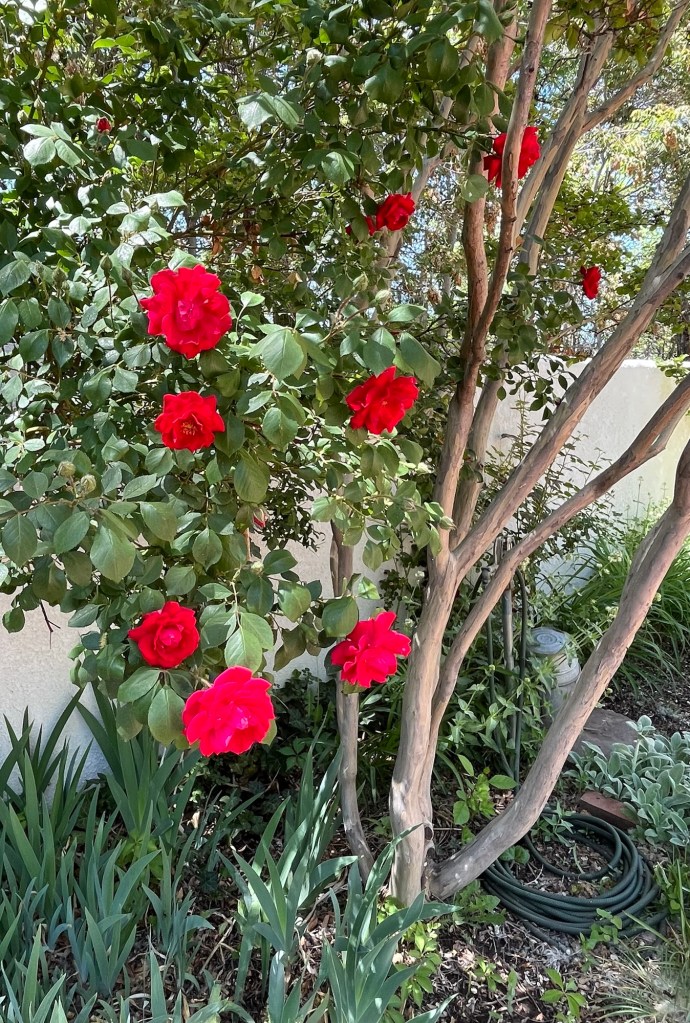
Our flight from ABQ to Dallas was delayed from about 1 pm to 8:30 pm. So here we are. Home for lunch in the patio, said goodbye to the roses again, and back to the airport for a 4:40 pm flight. Unless the plane to Paris is incredibly delayed, too, we will arrive a day late. The deadline just passed to cancel our Paris hotel without penalty. We may be spending 24 hours in DFW.😒
Morning, May 30. Paris
Hurrah! We’ve arrived at our hotel in Paris! Here’s the view from our window in the 13th. We had the usual queues and way finding difficulties and unbearable seats—can they possibly make them any smaller? It is quite warm here — upper 70s. Tomorrow we take the train to Vezelay.
Evening. May 30, Paris
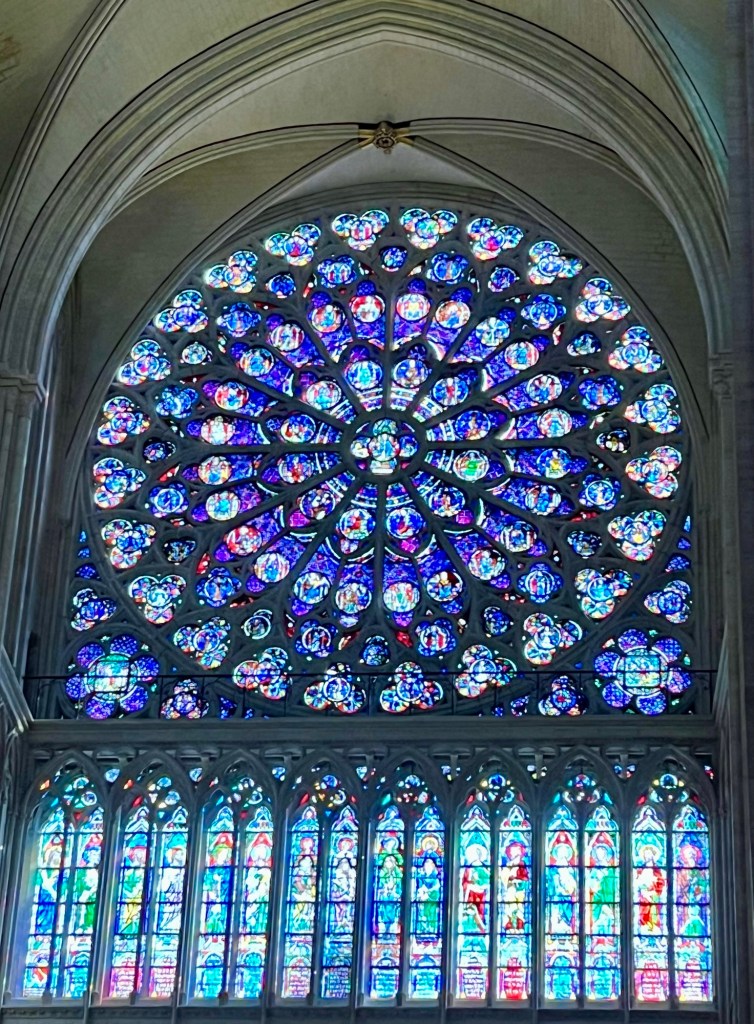
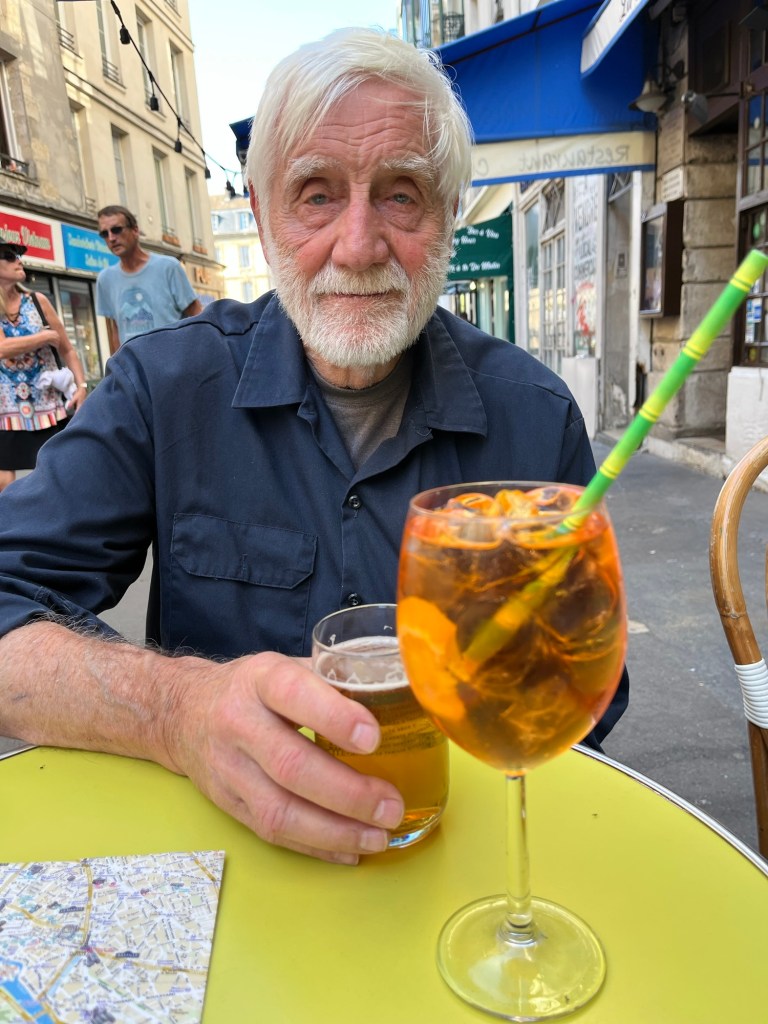
After a very short rest (Kent totally conked out) we decided to walk 4 km each way to Notre Dame and back. It was 80 degrees F, but we stood in the long queue to get in. Seems like it is not true you can get a pilgrim credential there, but we spent quite a bit of time. Then we took &a different route back, stopping twice for drinks and a light supper. I can hardly stay awake to type this, so here are a very few photos. To Vézelay by train tomorrow before 1 pm if we slept on the 9-hour overnight flight, it was only for a few minutes. Lovely to be back in Paris!
May 1, Vézelay
We walked through Paris to Le Gare de Bercy,had a lovely train ride and then a very hot walk 9 plus km from Sermizelles to Vézelay. It took us from 3 until 7 pm., with one short stop for beer at the only place we came to in Asquins. We had a warm welcome at the St. Madeleine Centre, and we were exceedingly hot.
It is a busy long weekend starting today with May Day, so we will be here two nights. and we will walk only 12 km on Saturday. No room at that distance tomorrow. By the time we got into our dorm room — the restaurants were closing, and there were not many of them. Thanks to the English-speaking priest who carried both of our packs 3 floors up curved old stairs.
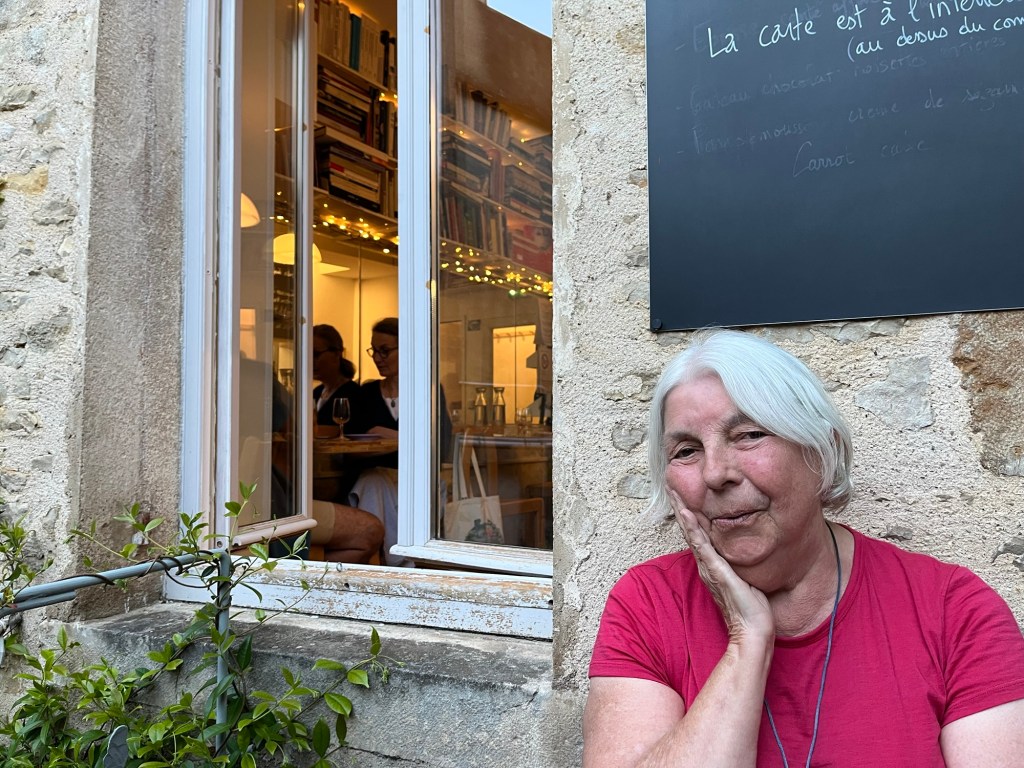
We did find a most interesting place run single-handedly by an innovative chef, but that’s too long to tell here now! Plus it is already 11 pm. and past lights out! We’re both in the women’s dorm as the men’s is pretty much full.
Thanks to daughter Psyche for managing to set up a Verizon wireless month-long travel plan for me as WiFi has been hard to come by and I couldn’t even connect with them through WiFi because I couldn’t receive text messages.
If anyone want’s to reach Kent in the next couple of days, contact me.
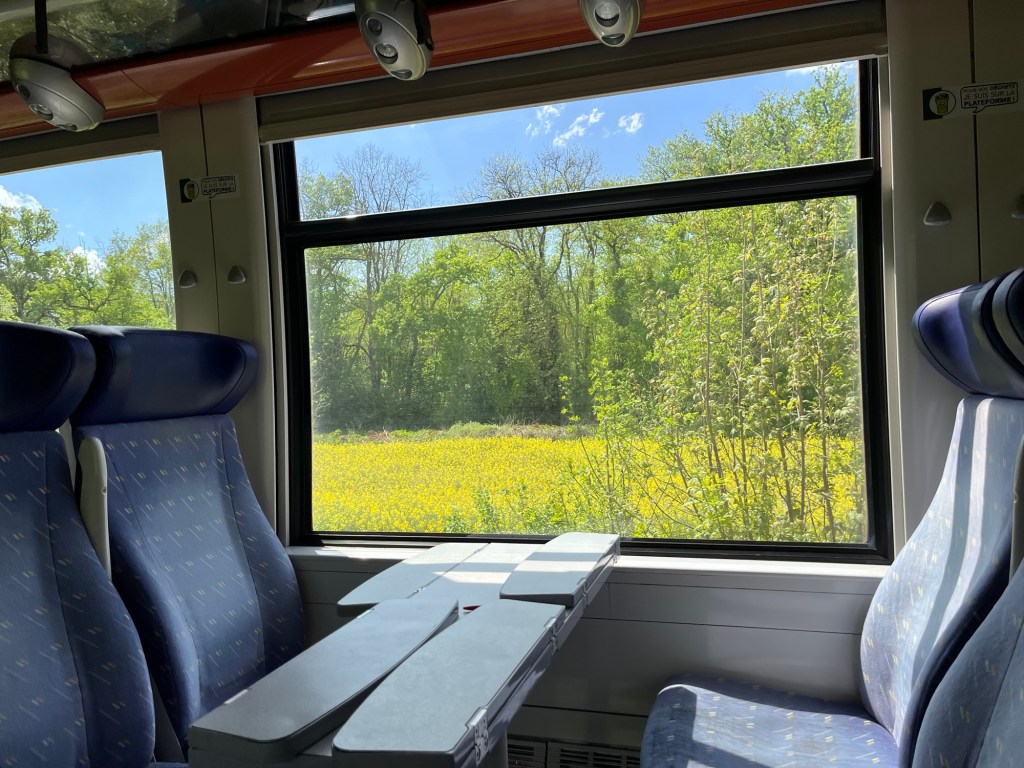
On the trainOur first bridge, GivryFirst sight of VézelayWelcome drinks to exhausted walkers in Asquinsalmost there!dinner at cuisine a vue
May 2 much Needed rest day in Vézelay
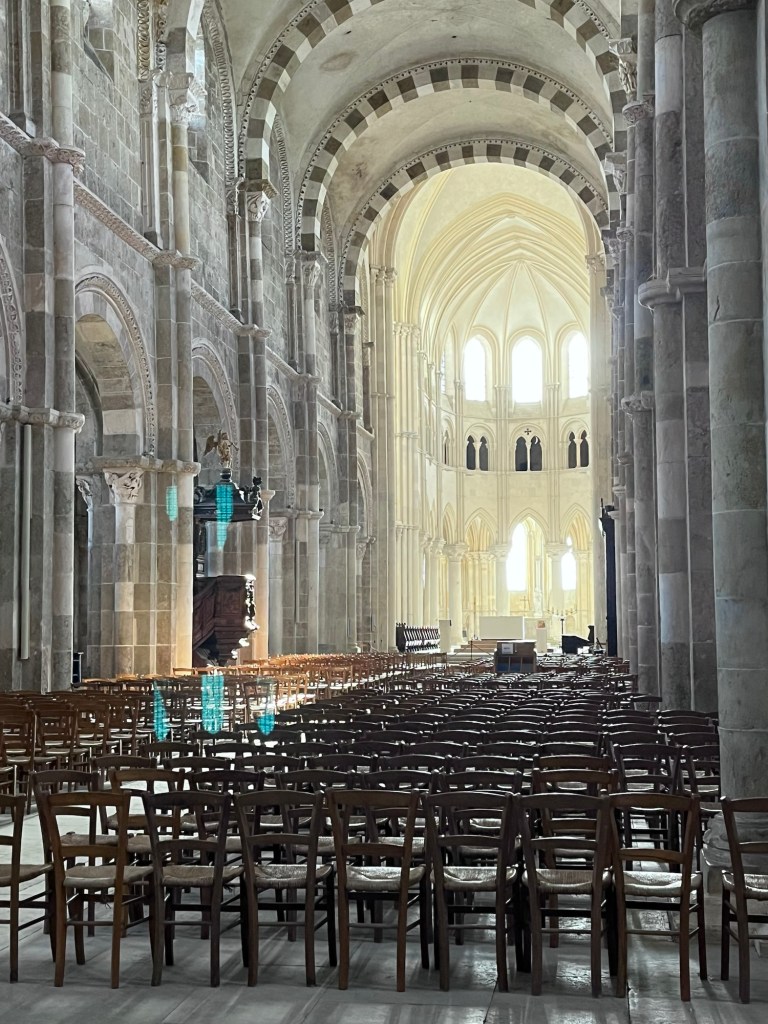
We are taking it easy, washing our clothes viewing the Basilica, having a leisurely lunch, getting money from a well-hidden ATM, impromptu concert, practicing my French, taking an afternoon nap. We’ll be ready to go early tomorrow morning! 11 k to Domecy sur Cure. Should be fairly short walk in cooler weather —maybe rain!
It is Ash Wednesday, 2023. We wait in San Francisco’s new Harvey Milk airport terminal, a spectacular tribute to the progress made in gay rights in the fifty years since the San Francisco commissioner’s assassination. My husband Kent and I are on the way home.
It is Ash Wednesday, 2023. We wait in San Francisco’s new Harvey Milk airport terminal, a spectacular tribute to the progress made in gay rights in the fifty years since the San Francisco commissioner’s assassination. My husband Kent and I are on the way home.
“I’m not going to get any ashes today. Have you seen anyone with ashes on their foreheads?”
“I haven’t noticed,” he says.
I was raised Presbyterian with a Swedish Covenant family background. Churches were plain. Crosses were bare, and there were no statues, few candles, and certainly none in front of statues of saints. Little glasses were passed along the pews for communion. There was no kneeling or walking to an altar. The Eucharist was a private affair between the pew-sitters and God. No one knew who participated and who didn’t. And no one put ashes on their foreheads on Ash Wednesday.
People walked up to the altar for a wedding or a baptism or were carried in a coffin for a funeral. They also went forward during evangelical revival meetings in answer to a call to be saved. Revival meetings, often held in tents, were not part of Presbyterian practices, but a couple of times, my Swedish Covenant relatives took me to tent meetings.
I still hear the preacher call on a long-ago summer evening, “Come forward to Jesus! Ask for forgiveness! Be saved!”
Am I saved? I wonder. Was it enough to say, “Now I lay me down to sleep,” each night before I go to bed and bring my dimes tied in a clean handkerchief for the offering on Sunday?
As if reading my thoughts, the preacher says, “Going to church on Sunday is not enough. Come forward!”
I give my uncle a questioning look. He doesn’t go forward, although lots of people do. I want to ask if he has already gone forward, but I don’t. He shakes his head, no, don’t go.
The preacher promises we’ll be “born again” and have eternal life in heaven instead of being tortured in the flames of hell. I worry about those flames of hell, but I know that even if I “get saved” tonight, nothing will change tomorrow. If I walk up and pray to get saved, I’ll be a hypocrite, which wouldn’t be good, would it? Maybe all those people going to the front are miserable and need saving. Will they go up over and over tomorrow, next week, or next year? Have they gone up before, or is once enough?
The preacher’s voice is compelling, “Come forward to Jesus!” My heart tells me I‘ll be damned if I do and damned if I don’t.
I sing silently, “Jesus loves me; this I know, for the Bible tells me so.” I pray, “Forgive me, Jesus. I love you, but I’m not joining that crowd. You’re not there, but with me here, aren’t you?”
That night, I dream of people screaming in the fires of hell.
Twenty-five years later, on my 33rd birthday, I married Ed, a divorced cradle Catholic. After years of soul-searching, I accompanied him to the St. Thomas Aquinas Newman Center at the University of New Mexico, partly because I thought his faith was stronger than mine. Newman reminded me of some of the more informal protestant churches I’d known. I attended classes, and after a nun said she wouldn’t tell me that I could not take communion, that it was a matter of my own conscience, I participated in everything, and our children were baptized.
Ed, divorced and remarried, was also not a bona fide Catholic according to official rules. He was eligible to apply for an annulment but refused to do so.
“I was married with six children. An annulment declares a marriage never existed. That is not true. My marriage was alive and good, but it died.” Like me, he followed his conscience.
I stayed at Newman for over twenty-five years, even after Ed’s death, until the archbishop removed the Dominican Order and barred women from the altar. Then, my conscience told me I had to leave. I still mourn the loss of that community.
But long before that sadness and years before Ed’s death, I asked him, “What happens on Ash Wednesday? I’ve never been. Can we go?” I remembered my childhood friends, who got ashes on their foreheads, made a fuss about not eating meat on Fridays, and wore pretty dresses and bride-like veils for the big event that was First Communion.
We go, and to my surprise, I am moved to the core.
“Dust, you are. To dust, you will return.” When I feel the fingers making the mark of the cross on my forehead, I think, “This is the ultimate reality.” I feel a deep peace and acceptance of my mortality. We’re born, we live, and we die. No exceptions.
That’s it.
Long ago, I memorized Henry Wadsworth Longfellow’s “Psalm of Life.”
“Dust thou art, to dust returnest, was not spoken of the soul.”
Longfellow was right. It’s not about the soul but the body. And I am my body, and I love my body, though ever since I was born, it’s been on its way to decay and death. I continue to go to Ash Wednesday services. Recognizing that I share a common destiny with every living thing comforts me.
I look around the airport. There is not an ash-smudged forehead in sight. We fly to Las Vegas, where I see not a single one during the four-hour layover.
“No ashes anywhere,” I say to Kent. “Of course, it’s Las Vegas!” Sin City. The concourses are jammed with slot machines.
We board a long-delayed flight to Albuquerque. I’m sad I’ve missed Ash Wednesday. Should I ask Kent to smudge some ashes from the fireplace onto my forehead and say those solemn, grounding words when we get home?
When the plane lands, I ask the young woman in the aisle seat,
“Are you getting off in Albuquerque?”
“Yes,” she says and faces me. I gasp and smile.
“You’re the first person I’ve seen today with ashes!”
She doesn’t react or smile. She’s wearing a blue sweatsuit. Several other young women nearby are similarly dressed.
“Are you with an athletic team?”
“Yes!”
“What kind?”
“Track.”
“What kind of track?”
“Middle distance running.”
“Oh, wow!”
I’m delighted to have met her and finally see ashes on one face today. I’m doubly pleased that she is a runner. I tell her how wonderful it is that she can do this because there was no women’s track when I was in high school. No women’s athletics at all. She’s probably wondering when this crazy old lady will shut up.
“I am still angry that none of us were allowed the opportunity to be athletes in those days,” I tell her. “It is so wonderful you can do this!”
I’m sure she has no idea how much meeting her today means to me. I am happy to have found one person with ashes on her forehead, and even more, she is a person whose life follows a path that was denied to me.
Even though I missed Ash Wednesday, I was not totally alone, and I am comforted. Lent continues tomorrow, and the truth remains. Dust I am. To Dust, I will return. We’re all in it together.
After a long absence from Caminobleu, I am sharing two December morning reflections with you instead of my usual Christmas letter.
December 19, 2024
We have returned from a month in Egypt and Greece, where we immersed ourselves in the history of two ancient cultures that have influenced Western civilization for thousands of years. Yet, more than the ancient ruins and their mysteries, I was fascinated by the lives of ordinary people, the farmers and fishermen (we saw no fisherwomen) along the eternal life-giving Nile and the people still living in simple stone houses, much as their ancestors did on the small Greek island of Syros.
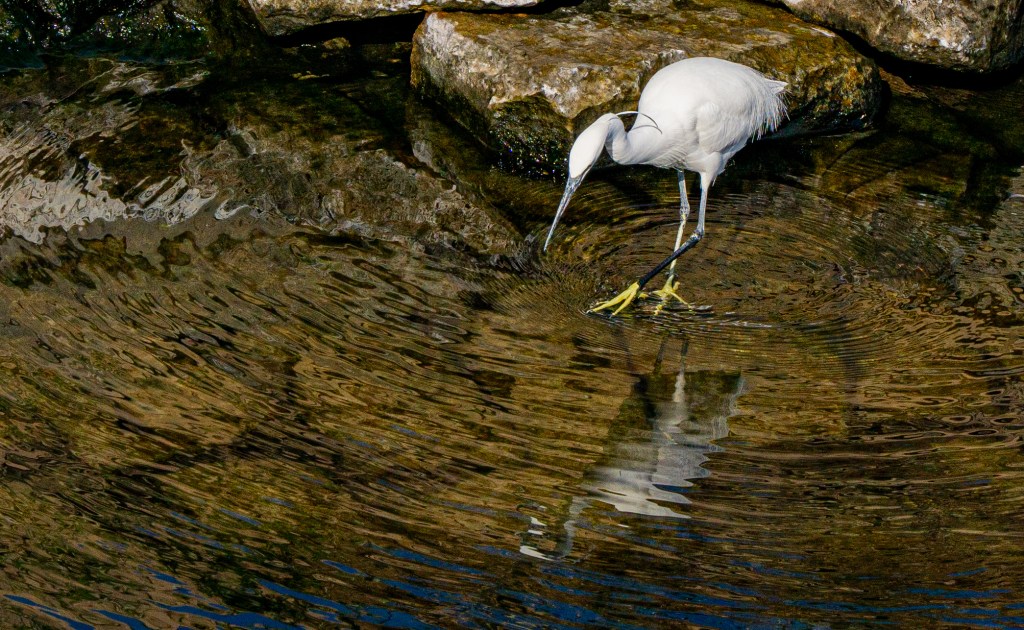
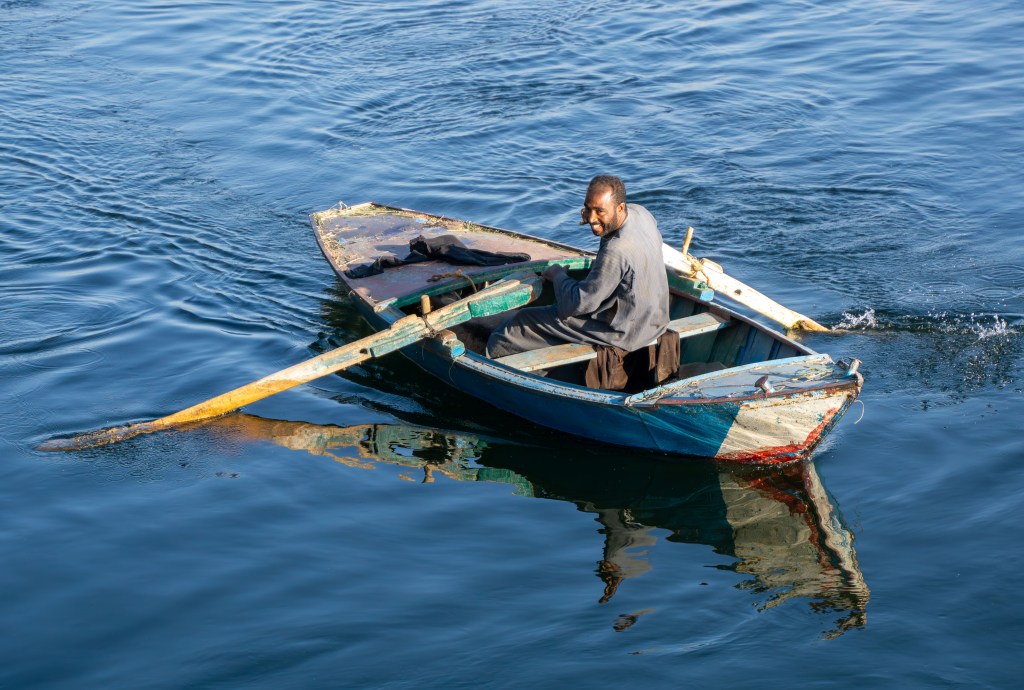
The herons, stilts, kingfishers, and small birds flitting through the trees and reeds along the Nile delighted me, as did the sunrises and sunsets. I was fascinated by the fishermen who rowed with clunky oars, usually two men in a boat: one young, one old. The old one handled the nets and studied the water, sometimes standing for a better view; the young one rowed, often in strong currents. I like to watch fishermen, perhaps because they remind me of my dad.
Snowy Egret on the NileFisherman on the Nile
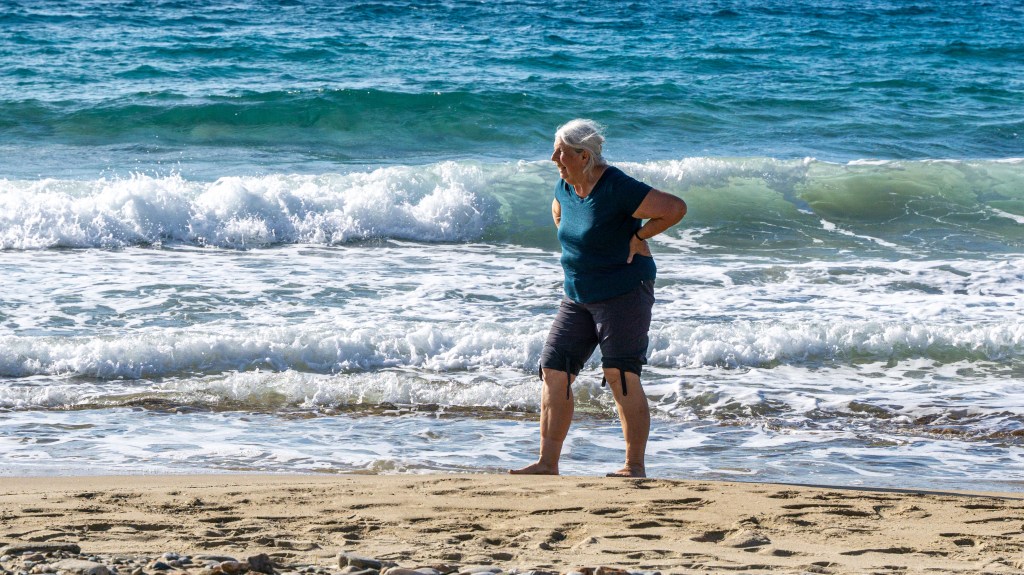
I loved the clear waters and brilliant pebbles on the Syros beaches, which reminded me of my childhood on Lake Superior. The autumn crocuses, struggling to bloom in the arid, rocky soil on the cliffs above the sea, brought back memories of autumn pilgrimages in France and Spain.
I photographed stones and waves on the beach and told Kent, “This is my happy place!”
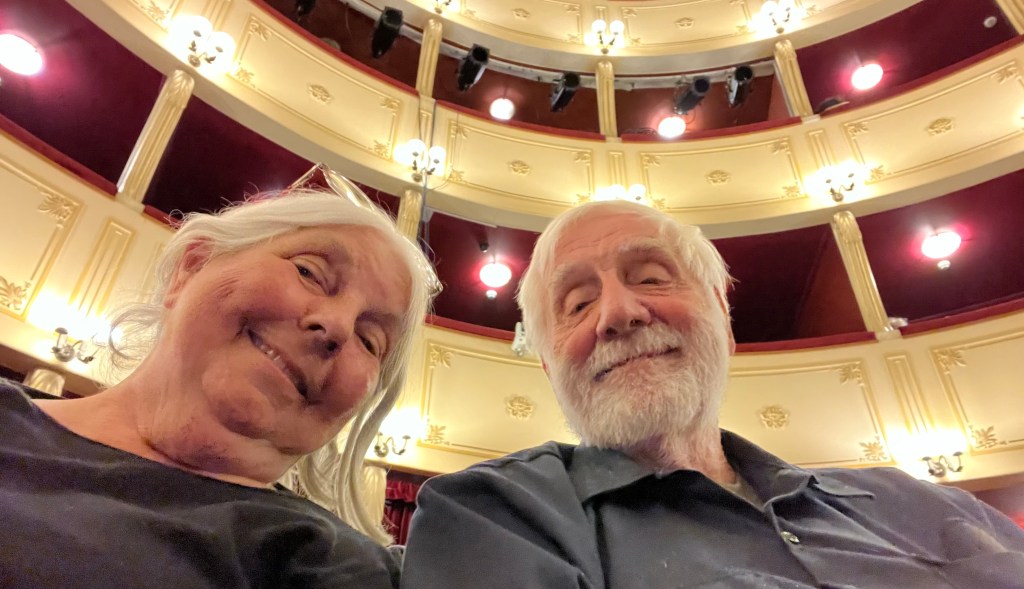
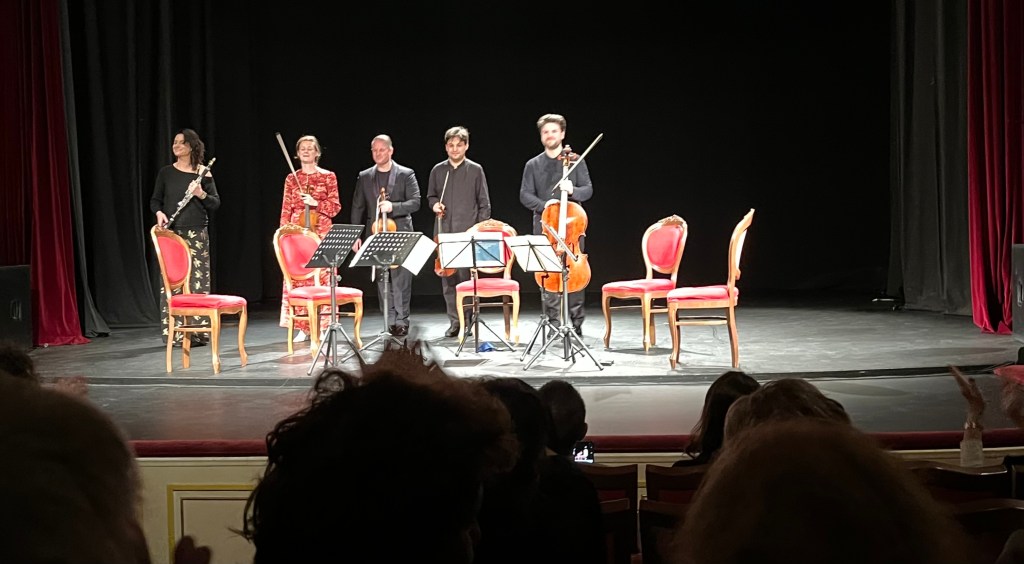
We took a ferry to Syros, seeking quiet after the intensity and crowds of Egypt and Athens. Our six-day visit coincided with the fledgling Syros International Chamber Music Festival, now in its second year. Violinist Pinchas Zukerman was the “grand old man” among the performers and organizers, but the younger musicians, their names hitherto unknown to us, were stellar. We attended all but one of five performances in the celebrated nineteenth-century Apollon theater, said to resemble La Scala.
I was touched by the participation of school children and the somewhat disorganized festival structure (performances started late, people wandered up and down forever looking for their seats, buying tickets was cumbersome, and people clapped in the wrong places). I recalled chamber music groups from the University of Michigan performing in the school auditorium in my small hometown of Newberry, Michigan, when one affable female violinist slept on our couch and shared our small bathroom without complaint. My parents faithfully attended the performances, enjoying the rare opportunity to experience what my dad called “highbrow culture.”
In October, we met Rebecca Reynolds at an author event she shared with Kent at Albuquerque’s Books on the Bosque. Although we’d just met, she cleverly used Kent’s decision to run away to sea as an example of an individual choosing to make a momentous change in his life. When Iwoke up this morning to begin reading the book, I found the first chapter of Thresholds of Change (Denver: Connolly Fox, 2024, so inspiring I stopped reading and wrote the following:
I am captivated by Reynolds’ use of the metaphor of the chambered nautilus. The nautilus creates new spiraled chambers as it grows, sealing each chamber except for one thread of living connective tissue called the siphuncle. As Reynolds describes it, “A core life-giving line that provides ballast and connects us to all parts of our lives, even those we’ve left behind.”
“The journey is what’s truly important.” Our experiences in life are not “over and done.” They are all connected.
As a pilgrim who sees my life as a journey, I like the concept of a living thread connecting all parts of my life.
I recall Tennyson’s poem “Ulysses.”
“I am a part of all that I have met.” These words mean more at eighty than they did at seventeen when I first read them in Miss Dwyer’s English class. I remember Miss Dwyer not only for what she taught but for her enthusiasm and implied belief in the importance of her subject matter. Through the siphuncle, the presence of Miss Dwyer and many family members, friends, and mentors connect my past and present.
At Miss Dwyer’s urging, we chose the final words of “Ulysses” as our Class of 1962 motto: “To strive, to seek, to find, and not to yield.” (How many of you remember your high school class motto?) This morning, I reread the poem in tears because I, too, now look back “from that sad height” (Dylan Thomas’s “Do not go gentle into that good night”) and reflect on the meaning and purpose of life from the perspective of old age.
Perhaps we live to love, learn, and grow in preparation for whatever comes next.
The dear friends I’m losing with increasing frequency remain part of my life forever. Sometimes, like this morning, my memories of them emerge through that life-giving core when they are least expected and most needed.
We have returned to a different America than the one we left. As the chaos and my feelings of foreboding intensify during this week before Christmas, I watch, wait, and pray for light to come as the world turns and the sacred sun returns.
“Yet all experience is an arch wherethro’ Gleams that untravell’d world, whose margin fades For ever and for ever when I move.”
“Come, my friends, ‘Tis not too late to seek a newer world.” – Tennyson, “Ulysses.”
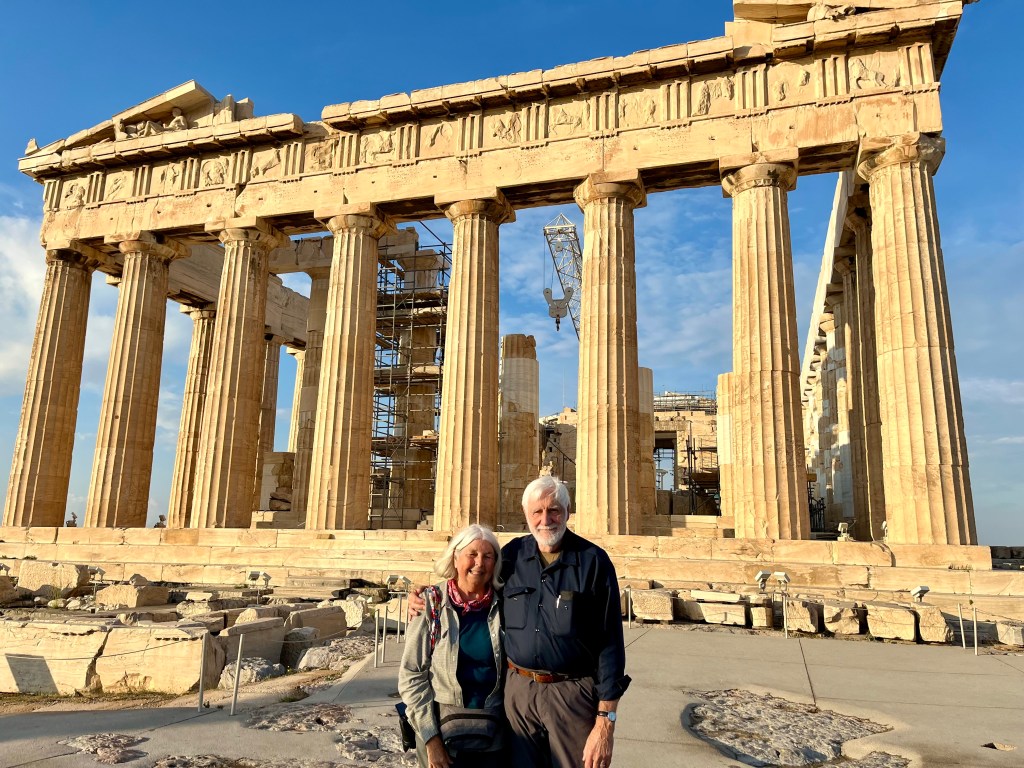
Linnea and Kent at the Acropolis early in the morning
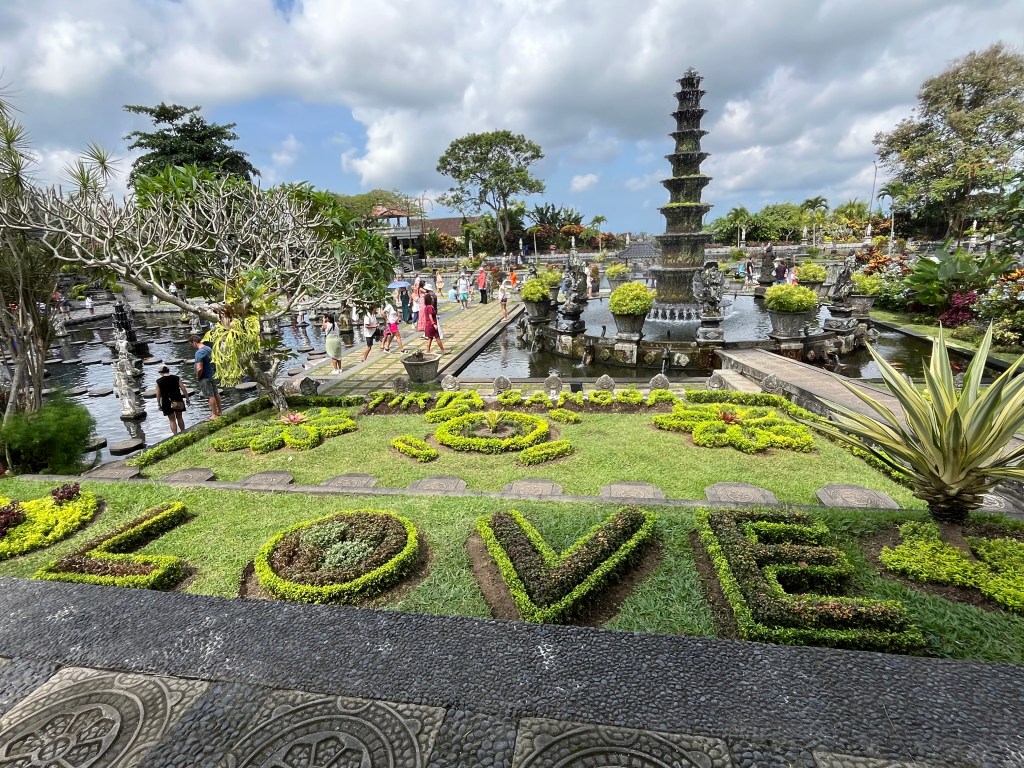
Back in San Francisco, Indonesia seems like a dream. The heat and humidity, the friendly, polite people, the heavy traffic, rice fields, trees, endless temples in Bali, beaches, and the mix of cultures are going to take time to process.
Today is my 80th birthday, but instead of partying it is, perhaps fittingly, a day of transition, a time to face the realities of old age, to be grateful for each day, and, for now, figure out how to finish this sentence before i fall asleep.








































 Caminobleu