
Shadows of the Past

It was always Grandpa’s house to me…Before dawn, I was startled awake by rapid flashes of strobe-like lights.

Grandpa’s House in early morning after the storm

It was always Grandpa’s house to me. The farmhouse, built by my great-grandfather in the 1880s, is filled with childhood memories. My great-grandfather, John Erickson, died forty years before I was born, and his daughter Lydia, my grandmother, died in her early fifties in 1928. I knew them only from stories told about them; but I loved my grandfather, Olof Olson, and greatly grieved his death when I was eleven.
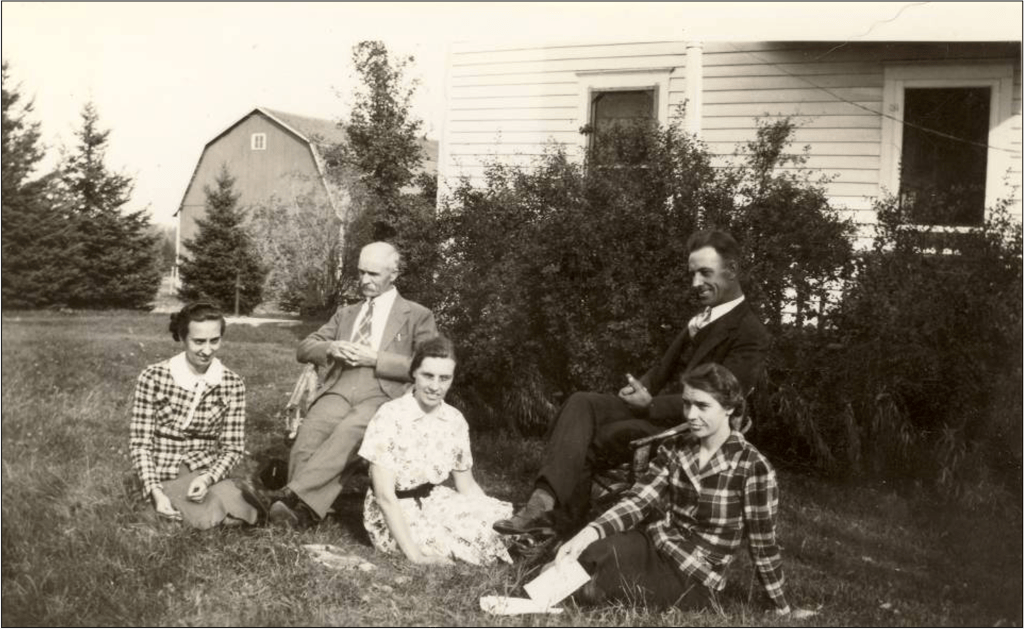
left to right: Elsie, Grandpa Olof Olson, Viola, Harold, Doris (my mother)

 My mother, her two sisters, and their brother grew up in the house, which they always thought of as home. Years after their deaths, they all live vividly in my memories.
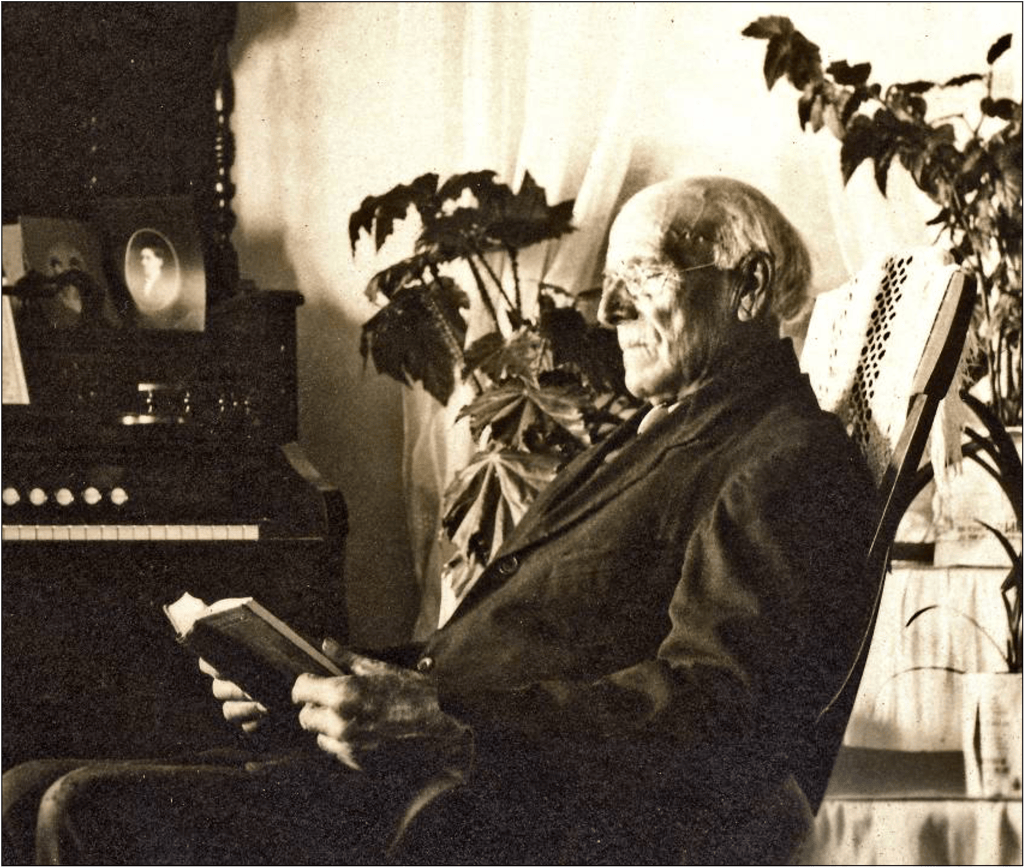
John Erickson
Great-Grandpa John Erickson by the organ

In September 2026, my husband Kent and I stayed in the house for the second time in four years following a long absence since my childhood. My cousin and her husband have invested much love and money into restoring and updating the house, although they do not live there.

We again slept in the west bedroom upstairs, the biggest in the house. Its double windows look out over the apple orchard. This is the room where great-aunt Gerda died in the 1950s after several years of dementia and confinement, a memory that still haunts me. I never saw her in her final years, but before she disappeared into that locked room forever, she paced in the hall, twisting her handkerchief in her hands. No longer able to speak, she made grunts and groans that I continued to hear behind the locked door.
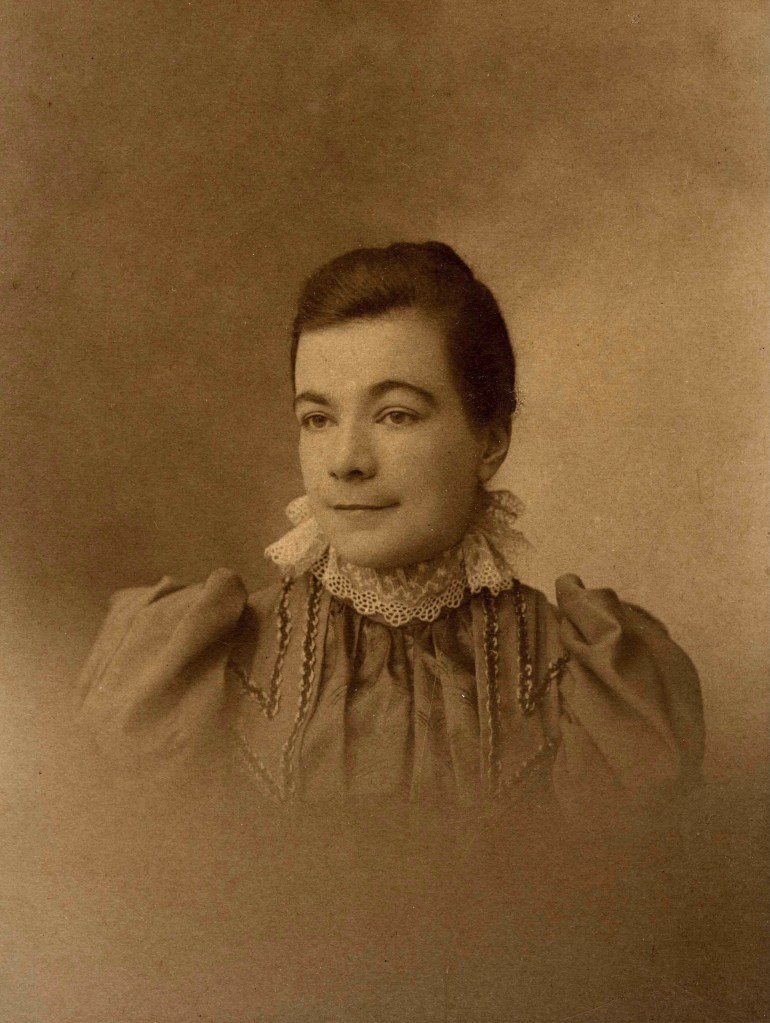
Aunt Gerda as a young woman

Kent and I, exhausted after three days of driving, slept soundly in the big bed, illuminated by nightlights that were almost too bright.

Before dawn, I was startled awake by rapid flashes of strobe-like lights. Was an alarm going off on my phone? No.

 I shook Kent awake, “Is your phone flashing?” It was not.

 I felt my way to the bathroom, flipped the light switch, and nothing happened. Then I realized the nightlights had gone out, and the only illumination was those bright lights flashing outside the house. Was there a police car in the driveway? Looking out the south window, I saw light pulsing behind clouds, unlike any lightning I’d ever seen. Could bombs be exploding? I heard no sounds, but I didn’t have my hearing aids on.

I went back to the bedroom and found Kent pulling on his clothes to go outside. “Do you hear any noises like bombs?” 

“No. I’m going to see what’s happening.” He thought the roof might be on fire.

“Don’t! There’s nothing you can do! It’s lightning. Come and see!” We both peered through the south window where the frequency of the flashes was already slowing.

We went back to bed. But I couldn’t go back to sleep. My phone indicated there might be a power outage in Menominee County, but the map showed no location.

My head was filled with thoughts of the old days when there was no electricity, no night lights and no phones. Electricity had come to the house just a few years before I was born. I remembered my shock when reading in Aunt Viola’s diary, “They hooked up the electricity today.” It was the late 1930s, and I realized that in my reading of the diaries up to then, I hadn’t pictured them living without electricity.

Memories overwhelmed me. Were my ancestors trying to send me messages? Had Aunt Gerda come back to haunt me? There had been so much life in that house, including mine as a young child. I was the first grandchild in the family, born when my grandfather was seventy-five years old. I remembered the voices, the laughter, the cries of those long-ago days. I remembered Aunt Viola (I called her Ola), scrambling eggs for my breakfast every morning in a pie tin on the wood stove. I recalled my childhood fears when lightning flashed, thunder cracked, and I ran to wherever Ola was sleeping and crawled into bed with her in search of safety.

I lay awake, reliving the past until, without warning, the nightlights came back on. For reassurance I looked out and saw a light on a pole in the yard across the road. I breathed more easily and fell asleep, plunging into an intense dream that had nothing to do with anything. Or did it?

I am at a conference in Venice, Italy, and I leave my backpack containing my money, phone, and identification unattended in a plaza when a woman I barely know insists I go on a walk with her. We walk together until she mysteriously disappears. I can’t find her anywhere.

I ask myself, how could I be so careless and so stupid as to leave my pack and follow her?  Am I losing my mind? I climb a hill and ask a policeman for help. He looks at me like I’m crazy. Nothing makes sense! Wait a minute! There aren’t any hills in Venice. I must be dreaming!

 With that realization, I wake up. Light is creeping into the sky. The nightlights are still lit. The dream and the ghosts are gone.
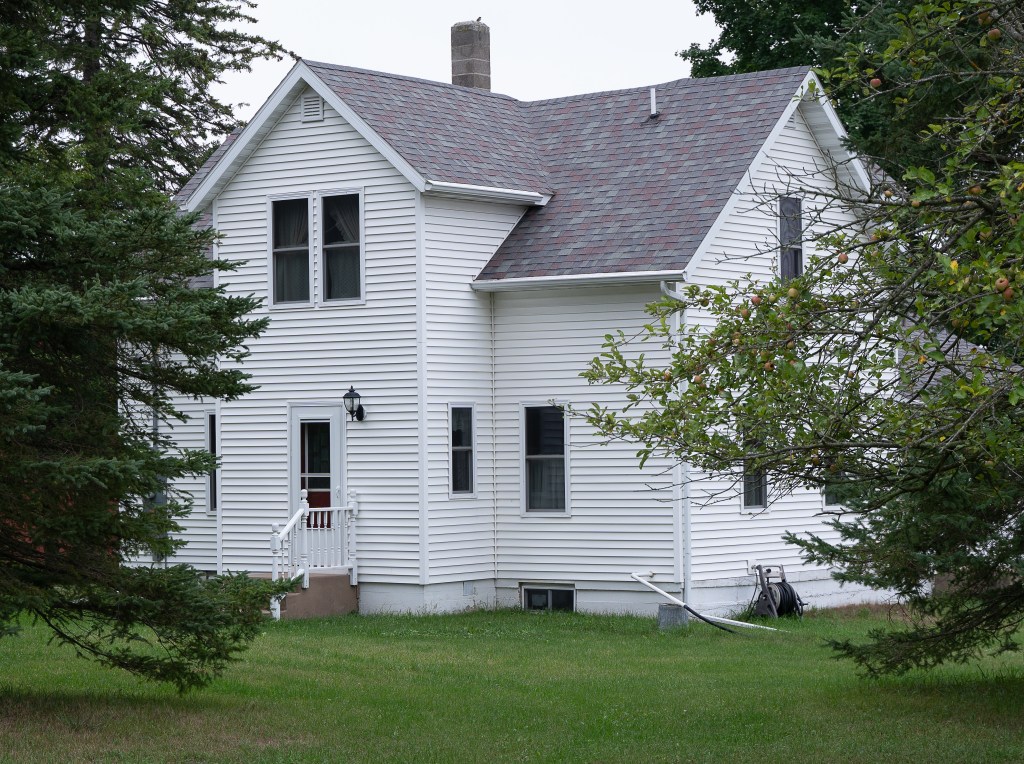
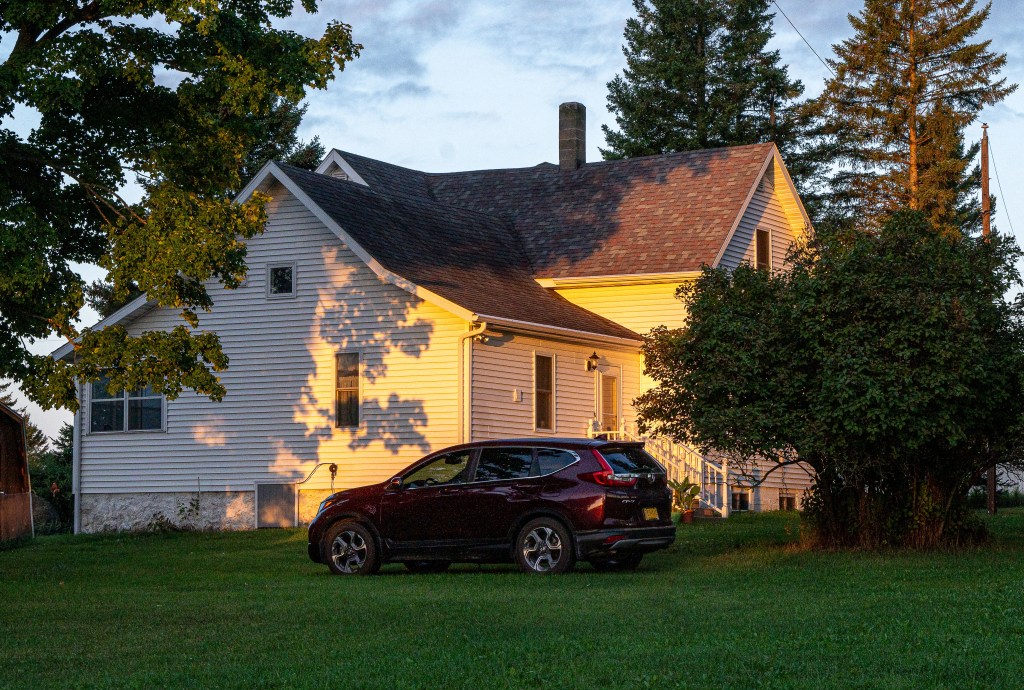
The house today from the front. The family portrait was taken just to the left. The double window is in the big west bedroom. South window is on the right. The once-open porch was enclosed when I was a child. I wrote this in the ground-floor room with three windows on the right.

I write this while lying on a couch that sits in the exact spot in the living room where my beloved grandpa died (although on an older couch) in September 1955. The memories keep coming. There are enough stories in this house to fill a book, and now I’ve added one more.

Family Feud

September 15, 2022

House from the road, built by John Erickson in the 1880s.

I thought a week’s stay in the 1880s farmhouse built by my great-grandfather would be an uninterrupted time of peaceful reflection amid a busy three weeks of visiting friends and relatives in three states. It was not.

There was no Wi-Fi to interrupt the day, although I could get faint internet access on my phone from an upper bedroom. My first cousin Harold, Jr. was at the farm when we arrived, repairing one of the sheds. We came to know Junior as a frequent visitor and inveterate talker. As Cindy said, perhaps he was trying to make up for all the years during which our families were estranged.

The driveway into the farm, Olson Road, Palestine, Michigan

The writing tips from the Ingram Sparks 30-day writing challenge say there should be no zig-zags in the storyline — no flashbacks. I think I’m breaking several rules right now: Extra words: “now,” “I think,” and using a –, and a flashback. But I find it difficult to tell a story, especially a memoir, without using flashbacks.

Upstairs memories: looking into the hall from the north bedroom, and holding the heavy wrapped brick that held the swinging door open at the bottom of the stairs throughout my childhood.

The reasons for the estrangement of the families go back to 1954, when my Uncle Harold, who was about to turn fifty, married Emma. Until then, he had lived on the farm with his sister Viola and their widowed father, Olof. Both Harold and Viola worked hard on the farm, although Viola also taught school and managed the household. In Viola’s eyes, no woman was good enough for Harold, whom she adored, and she had already thwarted at least one romance. The story goes that Harold bought a diamond for Ruthie Malmsten at my father’s jewelry store, but Viola threw a fit and put a stop to the engagement. Ruthie was not good enough for Harold, although the families had been friends for years.

Eventually, Harold found a wife in Emma, a widow twenty years younger who had two young boys, Milo (8) and Lyle (6). I was at the wedding, met my new cousins for the first time, and was envious as they set out on the honeymoon with their mother and her new husband. I wanted to go, too. Emma and Harold had a daughter Sylvia in a little over a year, and two years later, Harold, Jr. was born.

As anyone could have predicted, there was soon trouble between Emma and Viola, who had bought a farm half a mile down the road from the home place. Before he was married, Harold fixed up the house with a remodeled bathroom and other improvements. He and Emma moved into Viola’s house, called Jacobson’s Place, after the original owners, and Viola continued to live in her childhood home and cared for her father and elderly Aunt Gerda, who suffered from dementia and ended her life locked in the very upstairs bedroom in which I was now sleeping.

Gerda died in July 1955, and Olof that September. There seemed to be no good reason for Viola to continue living alone in the relatively large house. Harold had to drive to the farm to milk the cows each morning and evening. Emma demanded that Viola move out so she and Harold and their children could move in. I’m not sure where Harold stood, torn between his domineering sister, who loved him deeply, and his wife, but I know the fighting between his wife and sister caused him much anguish.

 It caused me anguish, too. In the summer of 1956, I stayed with Viola in the house that was strangely empty without my grandpa, Gerda, and Harold. There were horrible shouting matches outside the house between Emma and Viola. I ran away and covered my ears, not knowing what was going on and, like Harold, not knowing whose side to take.

Eventually, Viola left the home of her birth that she said Grandpa had promised would always be her home. The farm had been left equally to Harold and Viola. The enmity between Emma and Viola never diminished, despite the efforts of my mother to try to reconcile the two. We were all miserable, and the hard feelings continued, even after Harold built a new house for his family across the road from the old farmhouse and allowed Viola to move back to the family home, which she never did. Instead, she rented the place to a series of renters, each seeming to result in conflicts and altercations. Harold died in 1976 at the age of 71. I think he was a broken man. My mother died in 1987, Viola in 1995, the third sister Elsie in 1999, and Emma in 2004.

By 1977 I was married and had lived in distant places for many years, although Viola sent me frequent letters until her death, and I visited when I could. The 1960s and 70s were times of family conflict and separation because of disagreements over the Vietnam War and other issues larger than the conflict between Viola and Emma. It wasn’t until my children were born that I realized how important family contact was to me.

 Harold’s children inherited his half of the farm upon their father’s death, but it wasn’t until Viola’s death almost twenty years later that they had complete control of the property. I don’t know how long the dairy farm continued after Harold’s death. Junior told me recently that whenever some issue arose regarding the property, people tended to go to Viola rather than to him.

The first time I saw Junior after his childhood was on the eve of my Aunt Elsie’s funeral in 1999, the day before he was getting married, late in life, like his father. In 2007, after the death of my husband, I returned more often to visit the remaining relatives. We organized a family reunion that fall. Harold’s daughter, my cousin Sylvia, came to the reunion, where I greeted her with tears in my eyes. I had not seen her, either, since she was a child.

 Now, fifteen years later and eighteen years after Emma’s death, we cousins are still working on building our relationships and healing the rifts of our parents’ generation. Those rifts have left a long-lasting sadness caused by the pain and separation that lasted fifty years in what was once a loving, close family. Those years can never be recaptured. “Love one another. As I have loved you,” (John 13:34-35) is such an important commandment, yet not always easy to follow, as I am sure has been the experience of families other than mine.

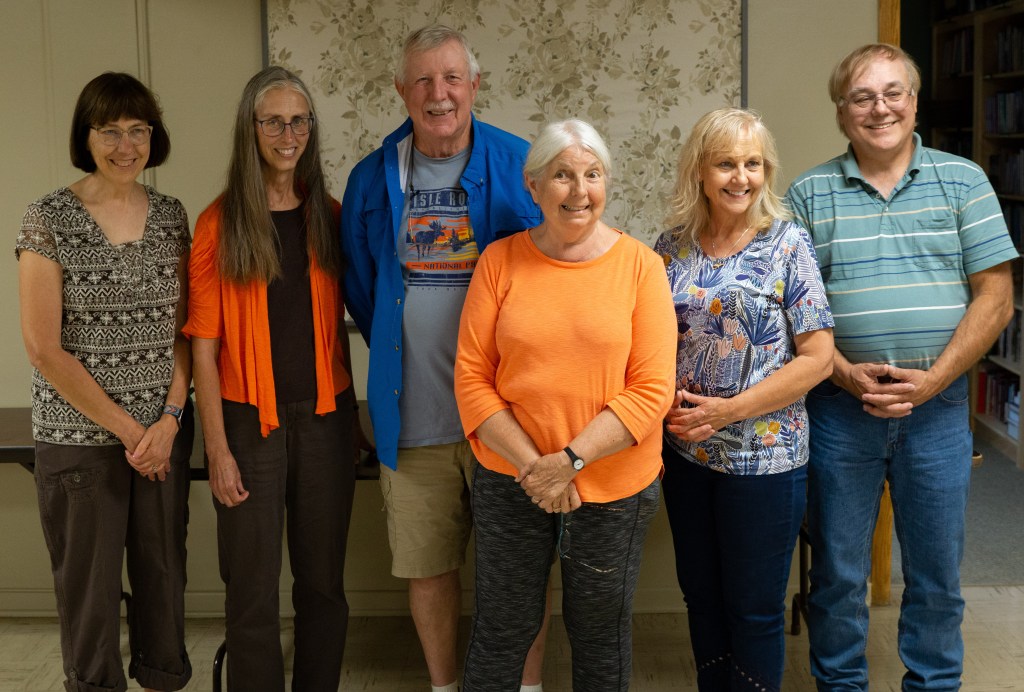
Here are six cousins enjoying time together in August 2022. Cindy, Mary, John, Linnea, Sylvia, and Harold, Jr. Milo and Lyle were not able to join us.